
You set the anchor, settled in for the night, and woke up to a shoreline that looks a lot closer than it did at sunset. That sinking feeling — the one that comes with realizing your boat is drifting — is one of the most avoidable problems in boating. Most anchor drags happen because of a predictable chain of small mistakes: too little scope, the wrong anchor for the seabed, or a set that was never properly verified. For a deeper foundation on the hardware side, these boat anchoring tips cover how rope selection affects holding power. This article focuses on what you can do before, during, and after you drop the hook to keep your boat exactly where you put it.
Quick Answer
Prevent anchor dragging by using enough scope (typically 7:1 to 10:1 for rope, based on depth plus bow height), letting the anchor set properly under reverse throttle, and confirming the hold with fixed landmarks or a GPS anchor alarm. Match the anchor type to the seabed, never anchor on too short a rode, and re-check your position whenever wind or current changes. Drag prevention is mostly about setup discipline and monitoring, not luck.
Key Takeaways
- Scope is the single biggest factor in holding power — use at least 7:1 for rope rode in normal conditions and more in wind or current.
- Setting the anchor is an active process: idle back at low RPM until you feel the rode come taut, then increase power briefly to confirm it holds.
- Verify your set with two fixed landmarks or a GPS anchor alarm before you relax, eat, or sleep.
- Anchor type matters — a plow, fluke, or Bruce-style anchor performs differently in sand, mud, rock, and grass.
- Re-check position after any significant wind shift, tide change, or when other boats swing near you.
Why Boats Drag Anchor in the First Place
Anchor dragging is rarely a mystery. It happens when the holding force your anchor can generate is less than the load the boat puts on the rode. That imbalance almost always traces back to one of four causes: insufficient scope, a poor set, the wrong anchor for the bottom, or a change in conditions you didn’t account for. Understanding which one applies to your situation is the fastest way to fix it, because each cause has a different solution.
A short scope is the most common culprit. When the rode is nearly vertical, the anchor is pulled upward rather than along the seabed, and most anchors lose the majority of their holding ability. The anchor needs a shallow angle of pull to dig in and stay buried. If you anchored in 15 feet of water with 30 feet of rode, you’re at roughly 2:1 — and that’s a recipe for dragging the moment the wind picks up.
Getting Your Scope Right
Scope is the ratio of rode length to the distance from the bow roller to the seabed. That distance includes water depth plus the height of your bow above the waterline — a detail many boaters forget. For rope rode, 7:1 is a reasonable working minimum in calm conditions. For chain, 5:1 is often adequate because the chain’s weight helps keep the pull angle low. In strong wind or choppy conditions, go to 10:1 with rope.
There’s a trade-off here: more scope means more swing room. In a crowded anchorage, deploying 10:1 might put you into your neighbor’s circle. The practical compromise is to find a spot with enough room for the scope you actually need, rather than anchoring in a tight spot and hoping 4:1 will hold. If space is genuinely limited, use a second anchor or a stern anchor to limit swing, but understand that this adds complexity and its own failure modes.
A Quick Reference for Scope
| Conditions | Rope Rode | Chain Rode |
|---|---|---|
| Calm, sheltered | 5:1 | 4:1 |
| Normal, moderate wind | 7:1 | 5:1 |
| Strong wind or current | 10:1 | 7:1 |
These are working guidelines, not laws. A heavy, well-designed anchor in good sand may hold at 5:1 where a lightweight anchor in soft mud would drag at 10:1. The bottom conditions matter as much as the numbers.
Setting the Anchor Correctly
Dropping the anchor and calling it set is the second most common mistake. A proper set takes a few deliberate steps.
- Bring the boat to a near stop, ideally into the wind or current, at the spot where you want the anchor to land.
- Lower the anchor to the bottom rather than tossing it — a controlled descent prevents the rode from tangling around the anchor.
- Pay out rode as the boat drifts back, keeping a light tension so the line stays clear of the anchor.
- Once you’ve reached your target scope, secure the rode and put the engine in idle reverse (or let the boat drift back under sail if you’re under sail).
- Increase to a moderate reverse throttle for a few seconds to dig the anchor in. You should feel the boat come to a firm stop and the rode go taut.
- Note your position relative to two fixed landmarks, or set a GPS anchor alarm, and watch for 60–90 seconds to confirm no movement.
If the anchor skips or the boat keeps moving, reset it. Don’t assume it will dig in later. A dragging anchor will often feel like it’s holding for a moment, then break free when the load increases, Before heading out on the water, it is also smart to consider safety gear for your land-based travels by checking out how do bicycle helmets protect the head in an accident.
Choosing the Right Anchor for the Bottom
No single anchor excels in every seabed. The type you carry directly affects how easily you can prevent dragging.
- Fluke (Danforth-style): Excellent in sand and mud, weak in grass, rock, and hard-packed bottoms. Lightweight and easy to stow, but can foul easily.
- Plow (Delta, CQR, Rocna-style): Good all-around performance, sets reliably in sand and mud, and resets well after a wind shift. Heavier and bulkier to store.
- Bruce/claw: Strong in sand and rock, sets quickly, and handles veering well. Less effective in soft mud.
- Mushroom: Intended for permanent moorings, not general anchoring. Poor holding in most bottoms.
The practical approach for most boaters is to carry a primary anchor suited to the seabed you encounter most often, plus a secondary anchor of a different type for backup. If you frequently anchor in grass or rock, a plow or claw anchor will serve you better than a fluke. If you mostly anchor in sand, a fluke anchor can be a solid, lightweight choice.
Monitoring and Adjusting After You Anchor
Even a well-set anchor can break free if conditions change. Wind shifts, tidal reversals, and passing wakes all load the rode differently. A few habits reduce your risk significantly.
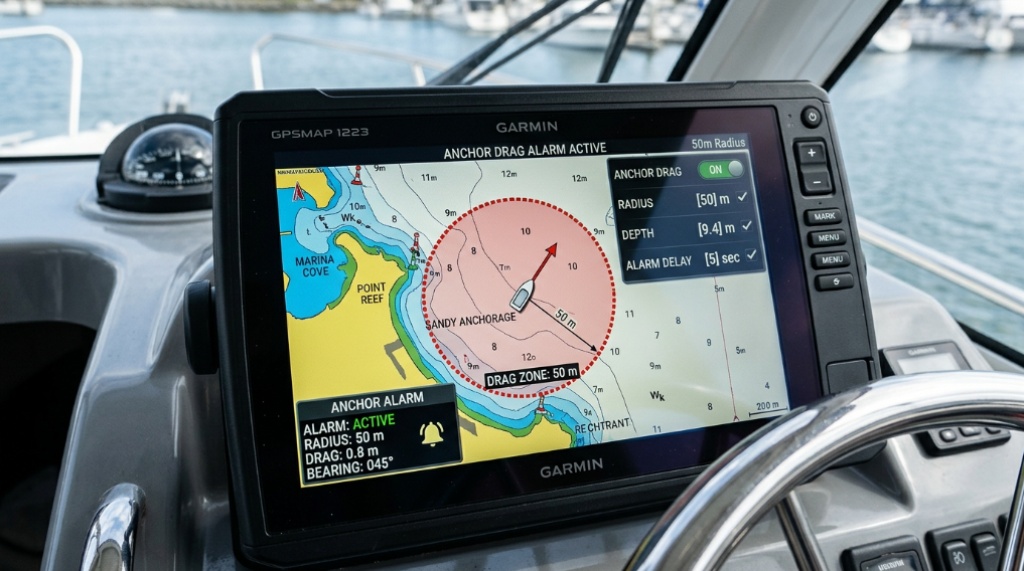
Use a GPS anchor alarm or a depth-based alarm if you have one. Set the radius based on your scope and swing circle — typically the length of your rode plus a margin. If you’re anchoring overnight, wake up once to check your position and surroundings. It’s a small inconvenience compared to waking up aground.
If the wind shifts 90 degrees or more, the anchor may need to reset. Most modern plow and claw anchors reset reasonably well, but a fluke anchor can pop out and not re-engage. After a significant shift, verify your position again. If you’re near other boats, watch how they swing relative to you — if your circles overlap, one of you needs to move before dark.
When to Re-Anchor Rather Than Wait
If you notice any of the following, resetting is safer than hoping. The boat has moved more than a few feet from its set position. The rode has gone slack repeatedly. You’re dragging toward a hazard, shallow water, or another boat. The wind has increased beyond what your scope was set for. In any of these cases, pulling up and re-anchoring with more scope or a different spot is the right call.
Gear That Helps You Hold
Your rode and anchor tackle affect holding as much as technique. An all-chain rode adds weight that keeps the pull angle low, which improves holding without increasing scope. A rope-to-chain combination with a proper length of chain — often 15 to 30 feet for a mid-size boat — is a common and effective compromise.
Snubbers and bridles absorb shock loads from waves and gusts, reducing the peak force on the anchor. A snubber is a stretchy line or rubber shock absorber attached to the rode; it prevents the anchor from being jerked loose by sudden loads. Swivels at the anchor shank reduce twisting, though they add a potential failure point and should be sized appropriately. Check shackles and connections regularly — a corroded shackle is a drag waiting to happen.
Frequently Asked Questions
How do I know if my anchor is dragging?
Watch two fixed landmarks — if their relative position changes, you’re moving. A GPS anchor alarm set to a small radius will also alert you. Other signs include a slack or vibrating rode, or the boat sitting differently than when you set the anchor.
What is the minimum scope I should use?
For rope rode, 7:1 is a reasonable minimum in normal conditions. Use 10:1 in strong wind or current. For chain rode, 5:1 is often sufficient in moderate conditions because the chain’s weight helps maintain a low pull angle.
Can I anchor overnight with a single anchor?
Yes, provided your anchor is properly set, your scope is adequate for the forecast, and you have an anchor alarm. Many boaters do this routinely. The key is verifying the set and monitoring conditions rather than assuming nothing will change.
Why does my anchor drag even after I set it?
Common reasons include too little scope, the wrong anchor type for the bottom, a fouled anchor that didn’t dig in, or a change in wind or current direction that unset the anchor. Resetting with more scope or a different anchor often solves it.
Should I use a second anchor to prevent dragging?
A second anchor can help in tight anchorages or when you need to limit swing, but it adds complexity and can tangle. For most situations, a single well-set anchor with proper scope and monitoring is simpler and effective.
Conclusion
Preventing anchor drag comes down to a few disciplined habits: deploy enough scope for the conditions, set the anchor under power, verify the hold with landmarks or an alarm, and pay attention when conditions change. Match your anchor to the seabed, keep your tackle in good condition, and don’t hesitate to re-anchor if something feels off. None of this requires expensive gear — just a methodical approach you repeat every time you drop the hook. Get those basics right, and you’ll sleep through the night instead of watching the shoreline creep closer.