You can learn BMX tricks safely by mastering bike control, braking, balance, and landing skills first. Start with basic movements, wear proper protective gear, and progress only when each skill feels controlled. A useful rule involves practicing five core skills before attempting advanced moves.
Learning BMX tricks looks exciting, but progression rewards patience more than bravery. Beginners often improve faster when they build reliable control before attempting impressive moves. In practice, riders should repeat each skill until they can perform it consistently without panic. This approach also reduces unnecessary crashes and helps develop better riding habits.
Why Basic BMX Skills Matter Before Tricks
Advanced BMX moves combine several basic skills at once. A barspin, tailwhip, or 360 requires balance, timing, body control, and accurate bike movement.
Therefore, weak fundamentals can make advanced tricks unpredictable. Strong fundamentals give you more options when something goes wrong during practice.
Think of BMX progression as building a control system. Each basic skill gives your body another response that you can use during harder movements.
Before learning advanced tricks, make sure you can:
- Control your speed confidently.
- Brake without losing balance.
- Lift either wheel when needed.
- Maintain body position during movement.
- Recover smoothly after small mistakes.
These abilities create the foundation for safer trick practice. They also make your riding more enjoyable because you spend less time reacting to avoidable problems.
Start With The Right BMX Setup
Your bike affects how safely you can learn new movements. A properly maintained BMX responds more predictably when you shift your weight or apply the brakes.
Before every practice session, perform a quick mechanical check. This habit takes little time and can prevent problems during high movement.
Check these areas:
- Tires: Confirm proper inflation and inspect for visible damage.
- Wheels: Check for loose spokes, wobbling, or unusual movement.
- Handlebars: Make sure they remain firmly aligned with the frame.
- Cranks: Check for unusual movement or looseness.
- Pedals: Confirm that both pedals remain secure.
- Chain: Look for excessive slack, damage, or poor alignment.
- Headset: Check for unwanted movement around the steering area.
Also inspect your riding surface before practicing. Remove loose objects, avoid wet areas, and stay away from traffic.
A controlled practice space gives you fewer unpredictable variables. Consequently, you can focus on technique instead of constantly watching for hazards.
Wear Protective Gear Every Practice Session
Protective equipment should become part of your normal riding routine. Do not reserve it only for difficult tricks or public demonstrations.
A properly fitted helmet provides essential head protection during falls. Gloves can improve grip while protecting your hands from scrapes and impacts.
Consider additional protection when your practice environment or skill level requires it:
- Knee pads: Protect your knees during falls and ground contact.
- Elbow pads: Reduce injury risk during sideways falls.
- Shin protection: Helps protect your legs from pedal strikes.
- Wrist protection: Provides additional support for some riders.
Gear cannot make dangerous techniques safe by itself. Instead, it adds another layer of protection while proper technique remains your primary defense.
Skill One: Master Basic Balance
Balance forms the foundation for almost every BMX trick. Before lifting the wheels, learn to control your bike while changing your body position.
Start by riding slowly across a flat, open surface. Keep your eyes ahead instead of staring directly at the front tire.
Next, practice standing on the pedals while maintaining steady movement. Shift your hips slightly forward and backward without making sudden steering corrections.
Then practice these movements:
- Ride slowly while standing.
- Shift your weight without changing direction.
- Keep your arms relaxed while riding.
- Practice controlled turns at different speeds.
- Stop smoothly after each movement.
Your goal involves controlled movement rather than maximum speed. Once your body responds naturally, later tricks become easier to understand.

Skill Two: Learn Effective Braking
Good braking control can prevent many unnecessary crashes. Beginners should understand how their brakes respond before attempting wheel lifts or jumps.
Practice braking at low speed first. Apply the brake progressively rather than grabbing it suddenly.
Keep your body centered while slowing down. Avoid throwing your weight forward because sudden weight transfer can disturb your balance.
Practice several controlled stops:
- Slow stop: Reduce speed gradually before stopping.
- Quick stop: Stop firmly while keeping the bike stable.
- Turning stop: Practice slowing while maintaining your intended direction.
- Emergency response: Practice stopping without locking the wheels.
Once braking feels predictable, you gain better control during trick attempts. More importantly, you develop a reliable way to abandon a movement safely.
Skill Three: Practice Front Wheel Lifts
A front wheel lift teaches weight transfer and prepares you for several BMX techniques. You should learn this movement before attempting larger manuals or advanced jumps.
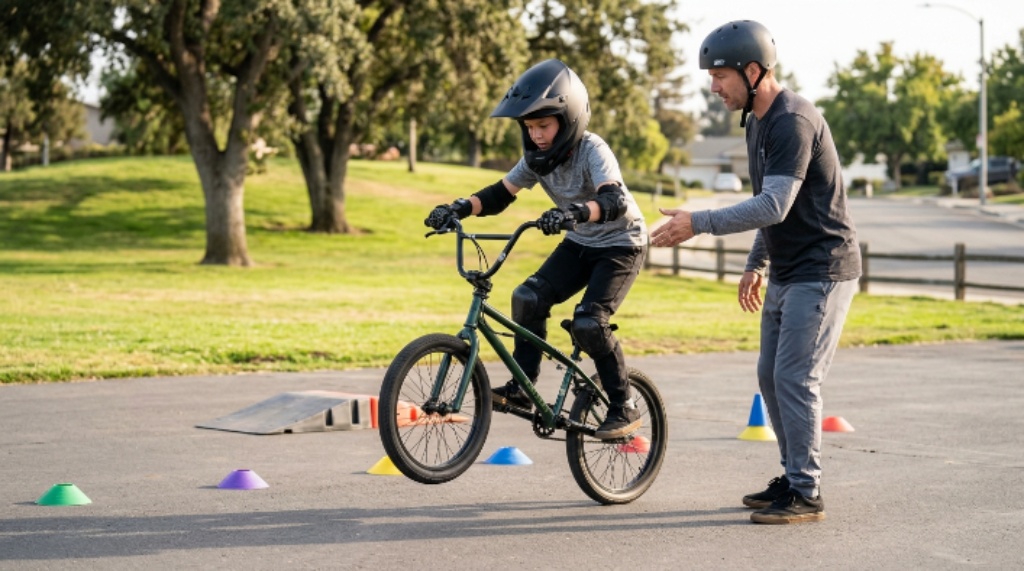
Begin at a very low speed on a smooth surface. Stand firmly on the pedals and bend your knees slightly.
Shift your hips backward while keeping your arms controlled. Allow the front wheel to rise naturally instead of pulling aggressively on the handlebars.
Practice lifting the wheel only a small amount at first. Then lower it gently and continue riding forward.
Focus on three things:
- Smooth weight transfer.
- Controlled front wheel height.
- Gentle wheel contact during landing.
Do not chase height immediately. Consistent control matters more than how high the wheel rises.
Skill Four: Develop Rear Wheel Awareness
Beginners often focus heavily on the front wheel. However, understanding the rear wheel becomes equally important as tricks become more complex.
Practice standing comfortably while feeling how your rear wheel responds to weight changes. Small body movements can significantly alter the bike’s balance.
Try lifting the front wheel slightly and returning it smoothly. Notice how your hips affect the bike’s position.
This exercise teaches an important BMX principle. Your body controls the bike through weight distribution rather than arm strength alone.
Skill Five: Learn Controlled Manuals
A manual introduces a more demanding form of balance. It teaches you to maintain the front wheel off the ground without relying heavily on pedals.
Start with very short attempts. Lift the front wheel slightly, shift your hips backward, and maintain a relaxed upper body.
Use your legs and hips to control the bike. Avoid pulling continuously on the handlebars because excessive arm movement can destabilize the bike.
Practice this progression:
- Lift the front wheel briefly.
- Hold the position for one second.
- Extend the hold gradually.
- Practice smooth front wheel returns.
- Increase distance only after consistent control.
A short manual with excellent control provides more value than a long manual that feels unstable.
Skill Six: Learn Safe Jumping Technique
Jumping requires preparation because poor landings can create substantial forces through your body and bike. Start with small, predictable jumps rather than large ramps.
Approach the jump with controlled speed. Keep your knees and elbows slightly bent so your body can absorb movement.
Maintain a balanced position through takeoff. Avoid leaning dramatically forward or backward unless the technique specifically requires it.
During landing, aim for smooth contact and controlled recovery. Keep your eyes focused toward the landing area rather than directly beneath you.
Practice small jumps until you can:
- Approach consistently.
- Leave the ground under control.
- Keep the bike stable in the air.
- Land without excessive impact.
- Continue riding smoothly afterward.
Only increase jump size when the smaller movement feels routine. Progress should follow control, not excitement.
How To Practice BMX Tricks Without Rushing
BMX progression works best when you separate learning from showing off. A trick should become predictable before you treat it as a performance.
Use a simple practice cycle:
- Learn the movement slowly.
- Repeat the movement several times.
- Identify one specific mistake.
- Adjust one part of your technique.
- Repeat until the movement becomes consistent.
Changing several things simultaneously makes progress harder to measure. Instead, isolate one technical problem during each practice block.
For example, if your front wheel lands too heavily, focus on landing control. Do not simultaneously increase speed, height, and distance.
Use Progression Levels Instead Of Trick Names
Trick names can make progression feel more exciting than it actually is. A better system focuses on the physical demands of each movement.
You can organize your progression into four levels:
Level One: Ground Control
Practice balance, steering, braking, weight shifts, and controlled stops. These skills should feel automatic before you move toward larger movements.
Level Two: Wheel Control
Practice front wheel lifts, rear wheel awareness, short manuals, and controlled landings. Keep every attempt small enough to maintain confidence.
Level Three: Air Control
Introduce small jumps and simple movements while airborne. Focus on body position, bike stability, and landing control.
Level Four: Advanced Combinations
Only combine movements after you can perform each component independently. This approach makes difficult tricks easier to break down and troubleshoot.
Know When You Should Stop Practicing
Fatigue changes your reactions, balance, and decision making. Therefore, continuing after your technique deteriorates can increase unnecessary risk.
Watch for these warning signs:
- You repeatedly miss movements you normally control.
- Your landings become noticeably harder.
- Your grip becomes weak.
- Your concentration starts drifting.
- You feel nervous before every attempt.
- Your body feels painful rather than simply tired.
Take a break when these signs appear. Returning later with better concentration usually produces more useful practice.
Choose A Safe Practice Environment
Your surroundings can influence your risk as much as your technique. Select a flat area with enough space for stopping and recovering.
Avoid practicing advanced movements near pedestrians, vehicles, stairs, crowded paths, or unexpected obstacles. Also avoid wet pavement because reduced traction can change braking and landing behavior.
A skatepark can provide useful riding space when you understand its rules. However, beginners should observe traffic patterns before entering busy sections.
Watch experienced riders for a few minutes. Then choose an area that matches your current ability rather than the most impressive feature available.
Common Beginner Mistakes To Avoid
Many BMX injuries happen because riders progress faster than their control develops. Avoiding common mistakes can make your learning process more efficient.
Attempting Tricks Before Learning Landings
Landing deserves as much attention as takeoff. Practice controlled landings before increasing jump height or movement complexity.
Using Too Much Upper Body Strength
BMX relies heavily on body position and weight transfer. Pulling aggressively with your arms often creates unstable movements.
Practicing While Tired
Fatigue reduces precision and slows reactions. End the session when your technique starts breaking down.
Copying Advanced Riders Too Soon
Experienced riders make difficult tricks look easy because they have developed strong automatic responses. Your progression should match your own control level.
Repeating A Failed Attempt Without Adjustment
More repetition does not automatically produce better technique. Identify the problem, make one adjustment, and try again.

How To Build A Safe Weekly Practice Routine
You do not need extremely long sessions to improve BMX skills. Consistent practice with clear goals can produce better results than occasional exhausting sessions.
A simple session can follow this structure:
- Warm up: Ride easily and practice basic turns.
- Control work: Practice braking and balance.
- Skill work: Focus on one beginner movement.
- Repetition: Perform controlled attempts with short rests.
- Review: Identify what improved and what needs work.
- Cool down: Finish with relaxed riding.
Keep your hardest practice for the middle of the session. Your body and attention should remain fresh enough for precise movements.
When Should You Move To Advanced Tricks?
Move forward when your current skill feels controlled rather than merely possible. You should repeat a movement successfully across multiple sessions before adding major difficulty.
You should also understand how to stop or bail safely when a movement goes wrong. That ability matters because advanced BMX tricks rarely go perfectly during learning.
Before advancing, ask yourself:
- Can I repeat the movement consistently?
- Can I control my landing?
- Can I stop safely after mistakes?
- Can I perform it without excessive tension?
- Can I recover when my balance changes?
If the answer remains yes, you have a stronger foundation for progression. If not, continue practicing the current skill.
Final Takeaway: Build Control Before Chasing Difficulty
Learning BMX tricks safely starts with basic control, not advanced movements. Master balance, braking, wheel lifts, manuals, jumping, and controlled landings before adding complexity.
Most importantly, treat every practice session as skill development rather than a test of courage. Wear suitable protective gear, inspect your bike, use a controlled environment, and stop when fatigue affects your technique.
Your next step should be simple: choose one beginner skill and practice it consistently before adding another. That steady approach can help you build confidence, control, and safer BMX habits for more advanced riding.
FAQs
What BMX trick should a beginner learn first?
A beginner should first learn basic balance, braking, front wheel lifts, and controlled landings before attempting tricks.
How long should beginners practice BMX tricks?
Beginners should practice while they remain focused and technically consistent, taking breaks whenever fatigue affects control.
Do I need protective gear for BMX practice?
Yes, a properly fitted helmet should remain standard equipment, while additional protection can suit your riding environment.
Can I learn BMX tricks without a skatepark?
Yes, beginners can practice many fundamental skills in a flat, open, controlled area.
When should I attempt advanced BMX tricks?
Attempt advanced tricks only after you can repeatedly control the required basic movements and recover safely from mistakes.