
It’s the middle of summer, and your tank thermometer is creeping toward the danger zone. You’ve watched your fish start to gasp at the surface, and you know the clock is ticking. High water temperatures deplete oxygen, stress your livestock, and can trigger deadly algae blooms. You need to act fast—but you also don’t want to spend $300 on an expensive chiller. The good news? You don’t have to. This guide will show you exactly how to reduce aquarium temperature budget-friendly, using everyday household items, simple DIY solutions, and smart management techniques that actually work.
What Is the Ideal Aquarium Temperature Range?
Most tropical community fish thrive between 74°F and 80°F (23°C–27°C). When the temperature exceeds 82°F (28°C), oxygen levels drop dramatically, biological filtration slows down, and your fish’s metabolism goes into overdrive. Knowing your target range is the critical first step—you can’t fix a problem if you don’t know where you’re aiming.
Why Do Different Setups Have Unique Temperature Needs?
Reef tanks typically run hotter (76°F–78°F) while cold-water species like goldfish prefer temperatures under 72°F. A planted tank with CO2 injection becomes risky above 80°F because gas exchange becomes less efficient.
How to Know If You Are in the Danger Zone?
If your thermometer reads above 84°F, immediate action is needed. Look for behavioral signs: rapid gill movement, fish lingering at the surface, or unusual lethargy. If you see these, don’t wait—skim through the solutions below and pick one immediately, Before adding new livestock to cool down your tank, make sure you know match fish species in an aquarium for long-term success to keep your ecosystem peaceful and thriving.
When Should You Start Acting to Cool the Tank?
Start intervention as soon as the water hits 80°F, not when it hits 86°F. Being proactive with the fans or slight water changes at that lower threshold prevents a potential meltdown during a heatwave in the afternoon.
How Can Household Fans Cool an Aquarium Effectively?
Evaporative cooling using a simple fan is often the most effective, cheapest, and quickest way to reduce temperature. A standard clip-on fan aimed directly at the water surface can drop a small to medium tank by 4–6°F within a few hours. The principle is simple: moving air accelerates water evaporation, which pulls heat away from the liquid.
Which Type of Fan Works Best for a Tank?
You have three choices: cheap desk fans, aquarium-specific clip-ons, or adaptable computer fans. The key is airflow width—you want a fan that blows across a large surface area rather than a fast-moving focused jet. For a 20-gallon long tank, a standard 12-inch oscillating fan set on low works wonders.
How Long Does Evaporative Cooling Take to Work?
Expect noticeable temperature drops within 30–60 minutes, but full equilibrium takes roughly 4–6 hours. You must compensate for evaporated water with daily top-offs, or your salinity will spike in marine tanks. Always top off with freshwater if you’re doing this.
Can You Combine a Fan with a Controller for Better Results?
Smart plug timers paired with a basic temperature probe can cycle the fan on and off. This prevents overcooling during the night when ambient room temperature drops. A simple mechanical timer is fine—run it from 11 AM to 5 PM to offset the heat of the day.
Why Is Ice the Enemy of Stable Tank Temperature?
Using ice directly in the tank is the #1 myth in aquarium keeping. While it drops temperatures instantly, it does so unevenly. Fish get thermal shock, pH swings occur due to condensation, and the temperature bounce back within an hour is far more dangerous than just having a warm tank. Never put ice in the water.
So What Is the Safe Way to Use Ice?
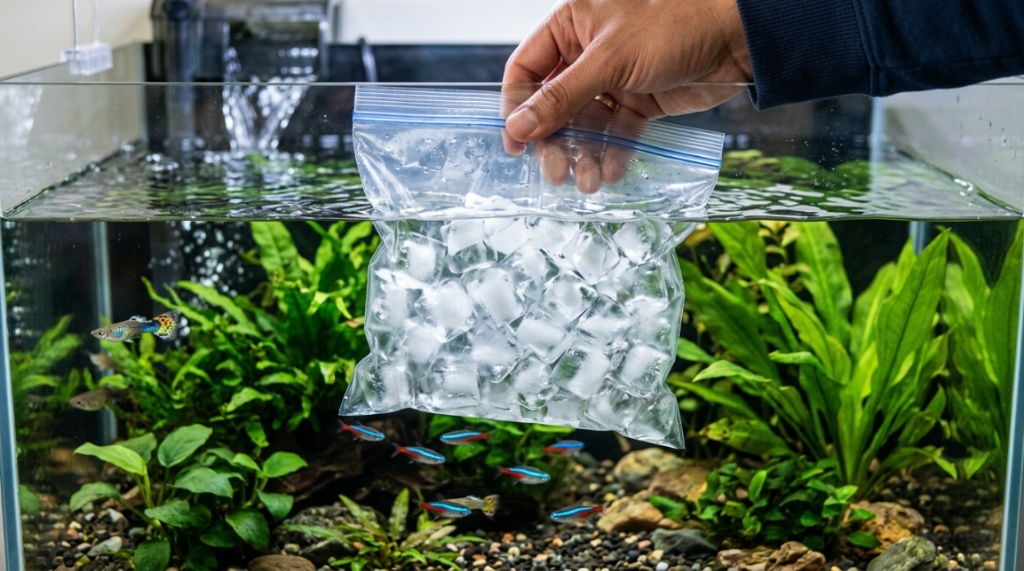
The safe method is indirect cooling: freeze water in a clean plastic bottle and float it in a sump, a high-flow area, or the filter intake. Alternatively, place a sealed bag of ice on top of the tank lid where the water circulates underneath. This allows gradual cooling without destroying tank chemistry.
What Are the Risks of Rapid Temperature Changes?
A rapid 5°F drop in 15 minutes can kill sensitive invertebrates and cause whitespot (Ich) outbreaks. Your fish’s immune system drops when temperatures fluctuate wildly. Slow cooling—about 1°F per hour—is the absolute maximum safe rate.
When Is Ice Actually the Only Option?
If your tank hits 88°F+ and fish are about to die, prioritize survival. Use the bottled water method, but calculate the volume: use 1 frozen bottle per 10 gallons, remove it as soon as the tank hits 84°F, and let the fan handle the rest.
Which Aquarium Chiller Models Offer the Best Price-to-Performance Ratio?
If you live in a hot climate and fight high temperatures daily, investing in a compact thermoelectric chiller is worth it. While the initial purchase seems costly, these units use very little electricity, and you can find peltier-based units that cool 20 to 30-gallon tanks to 4°F below ambient for under $120.
For affordable options that balance price and efficiency, you might explore specific devices designed to reduce aquarium temperature budget constraints without sacrificing reliability. These units specifically target the mid-range market, offering reliability without high-end price tags.
What’s the Difference Between Compressor and Thermoelectric?
Compressor chillers are powerful and control larger tanks but cost $300+. Thermoelectric units (peltier) hold no refrigerant, all-solid-state, and are relatively silent, but they cannot outperform a temperature differential of more than 15°F. For a standard 20-gallon long aquarium, the thermoelectric type is all you need.
How Many Watts Should You Look For in a Budget Chiller?
For a 20 to 40-gallon tank, a minimal 60–80 watt thermoelectric unit is sufficient. If you are cooling a heavily stocked 55-gallon tank, you need 100 watts but be prepared for a higher bill. Read the specs on “gallons capacity” carefully—manufacturers often overestimate the tank size for a 2°F drop.
Can You Build a Small DIY Chiller with a Computer Radiator?
Yes. By running your canister filter output through a car heater core and attaching a 120mm PC fan, you create an effective evaporation cooler. But this is more complicated for beginners—simpler to buy a clip-on fan for immediate relief.
How Much Can Water Changes Lower the Temperature?

Performing a 25% water change with cooler (but not cold) tap water can instantly drop the tank temperature by 2–3°F. This is a fast-acting rescue measure, but the effect is temporary unless the room is adequately cooled. Match the new water to a temperature that is 4°F lower than the tank’s current temp.
What Is the Ideal Water Change Protocol During a Heatwave?
Instead of your weekly 25% change, do a 10% change every morning and evening. This reduces heat stress without churning the substrate too much. Use a siphon to remove water that has been sitting in a warm room, and replace it with water from a cool, shaded bucket.
Why Should You Never Use Cold Water Straight from the Tap?
Cold tap water is supersaturated with gases and lacks oxygen exchange time. It can also shift the pH dramatically if your source water parameters differ from your tank. Always store water in a container in a cool place for at least 2 hours before adding it.
Which Water Change Mistakes Elevate Heat Problems?
Using a pump that generates friction heat is one. Another is leaving the new water bucket in direct sunlight and inadvertently introducing warmer water. Always pre-chill the replacement water to below the tank temp before starting the exchange.
Can Lighting Cause Excess Heat and How Do You Fix It?
T5 and metal halide lights can account for up to 15°F of unwanted heat in a sealed canopy. Switching to LED lighting drastically cuts energy consumption and immediate radiant heat. A simple LED bar upgrade can reduce tank temps by 4–5°F while improving plant growth.
How Many Hours of Light Should You Use in Summer?
Reduce photoperiod from 8 hours to 6 hours during the hottest hours of the day. If you have no live plants, turn the light off completely during the 12–3 PM heat peak. Use a smart timer to make this adjustment automated.
What Is the Best Ventilation Setup for a Tank?
Remove the glass canopy altogether—this alone can lower temperatures by 2°F by allowing heat to escape. If you have jumpers, use a screen mesh instead. Aim to have the lights sit at least 4 inches above the water surface to avoid the “oven” effect.
Does the Ambient Room Temperature Dictate the Tank Temp?
Absolutely. If your room is at 90°F, your tank will stay stuck at 82°F no matter what you do internally. Using blackout curtains or fans in the room drops ambient temp, which effectively reduces the max temp your tank hits.
How to Insulate Your Tank to Keep Cool Water Stable?
While we usually insulate cold water in winter, adding a reflective barrier to the back glass during a hot summer can prevent radiant heat from walls from entering your tank. Use a simple foam board with a reflective face on the back outside of the glass.
Why Does the Tank Get Hotter in the Afternoon?
Solar gain from nearby windows heating the wall. Your aquarium can act like a solar collector through the front glass. Placing a white sheet or reflective bubble wrap across the glass during peak sun hours can reflect up to 30% of radiant energy away.
When Should You Use Acrylic Paints or Decals on the Back?
A dark background paint or foam board actually absorbs more heat than a white one. Black absorbs infrared, while white reflects it. Switch your background to a white/cream color if you struggle with overheating during summers.
Can You Place a Fan Behind the Tank Air Gap?
Yes. Creating an air gap of at least 1 inch behind the tank and placing a fan there dramatically improves airflow past the glass. This pulls heat out from the back panel—important because most of the heat transfer occurs through the main back glass panel.
When Should You Use a Cooling Fan vs. a Chiller?
A fan is your primary weapon for 95% of households, especially if you can keep the room below 78°F. You should switch to a mechanical chiller only if the humidity in your room exceeds 70%, because a fan will stop evaporating water effectively at that humidity level.
What Humidity Level Stops Evaporative Cooling?
When relative humidity approaches 75%, water molecules in the air slow evaporation, causing the fan to stall. If you’re near a bathroom or in a coastal climate, fan effectiveness drops by 75%. In such cases, a thermoelectric chiller is the better budget option over prolonged summer months.
How to Calculate Evaporative Cooling Efficiency?
Measure the tank temp, then measure the room relative humidity. If the difference between the wet-bulb temperature and air temp is less than 5°F, you must use a dehumidifier or just accept you have to use frozen bottles. In arid desert environments, simple fans can remain effective up to 98°F airflow.
Why Do Some Tanks Need Both Active and Passive Cooling?
Large 75-gallon tanks have a low surface area to volume ratio, reducing natural evaporation. For these, you need a fan plus floating insulation sheets on the top. In high-volume tanks, thermal mass slows down cooling; you must stack methods: fan + water changes + shade.
What Is the Fastest Emergency Method for Overheating?
If fish are already gasping, immediately: (1) point another fan at the filter output, (2) do a 10% cooler water change simultaneously, and (3) drop a frozen bottle in. This combination acts within 5 minutes and prevents heat stroke while stabilizing your ecosystem.
Why Does Filtration Flow Affect Cooling Efficiency?
The movement of water accelerates heat exchange with the air. By point a fan across the filter outflow, you ensure that warm water circulates rapidly to the surface where it can evaporate. Stagnant water traps heat and makes cooling impossible.
Can You Turn Off Heater Features During Summer?
Remove the heater completely and store it. A heater can keep a tank at a consistent high temp even when the ambient air is much lower at night. Disconnect all heating devices if the ambient temp stays above your target by several degrees.
How Long Will the Fish Fight Before They Are Affected?
Chronic stress occurs after 48 hours in temps above 85°F. Immediate damage starts at 90°F. Don’t wait for them to show symptoms—take full action while they look fine.
Frequently Asked Questions
Can I use ice packs meant for food coolers in my aquarium?
Yes, but only if they are completely sealed and made of non-toxic material. Never use undiluted blue gel packs, as they can rupture and leak into the tank. Wrap them in a plastic bag and float them only if sealed tightly.
Are water coolers with fans noisy?
Budget fans can generate moderate noise, especially clip-ons. Look for 120mm PC fans with a low dB rating (below 25 dB). Many aquarium hobbyists adapt AC-powered quiet computer fans for continuous 24/7 operation.
What is the cheapest method of all?
The cheapest method is a household box fan placed beside the tank—not even touching it. If you already have one, you can cool a 40-gallon tank for zero dollars. Use it on low speed to reduce humidity and continue evaporation without buying extras.
Can a high-quality plant light still heat the water?
Yes, high-intensity LEDs emit near-infrared radiation. Even if the fixture is cool to touch, the light itself heats surfaces. Keep LEDs at 8 inches above the water and adjust the photoperiod to avoid midday peaks.
When should I worry about tank temp during winter?
During winter, overheated room radiators cause temperature spikes. Monitor the tank temp daily as home heating systems intermittently overheat spaces. Use a small fan to equalize if you see spot readings over 80°F in January.
Conclusion
Reducing your aquarium temperature without breaking the bank is a balancing act of evaporation, airflow, and simple household hacks. Start with a fan and leverage water change cycles, LED upgrades, and shading before you even consider an expensive chiller. Each method is science-proven, and you can combine them for a cumulative 8-10°F drop that keeps your fish safe, happy, and thriving all summer long. Don’t let heat defeat your aquatic hobby—start with one tip from this list today, and your fish will thank you tomorrow.
Now that you know exactly what to do, inspect your tank now and choose two methods to apply this afternoon. If you notice the water creeping above 82°F, grab a fan and start the water movement. Keep an eye on the thermometer hourly, and you’ll dial it in by dinner time. Your fish are counting on you—act before they show distress signs