
Key Takeaways
- Filters do not act like simple sieves that block particles by size alone.
- Diffusion traps the tiniest particles through random, bouncing motion.
- Interception catches mid-size particles that drift close to a fiber.
- Impaction stops larger particles that cannot avoid a fiber’s path.
- The hardest particle size to catch sits right in the middle, around 0.3 microns.
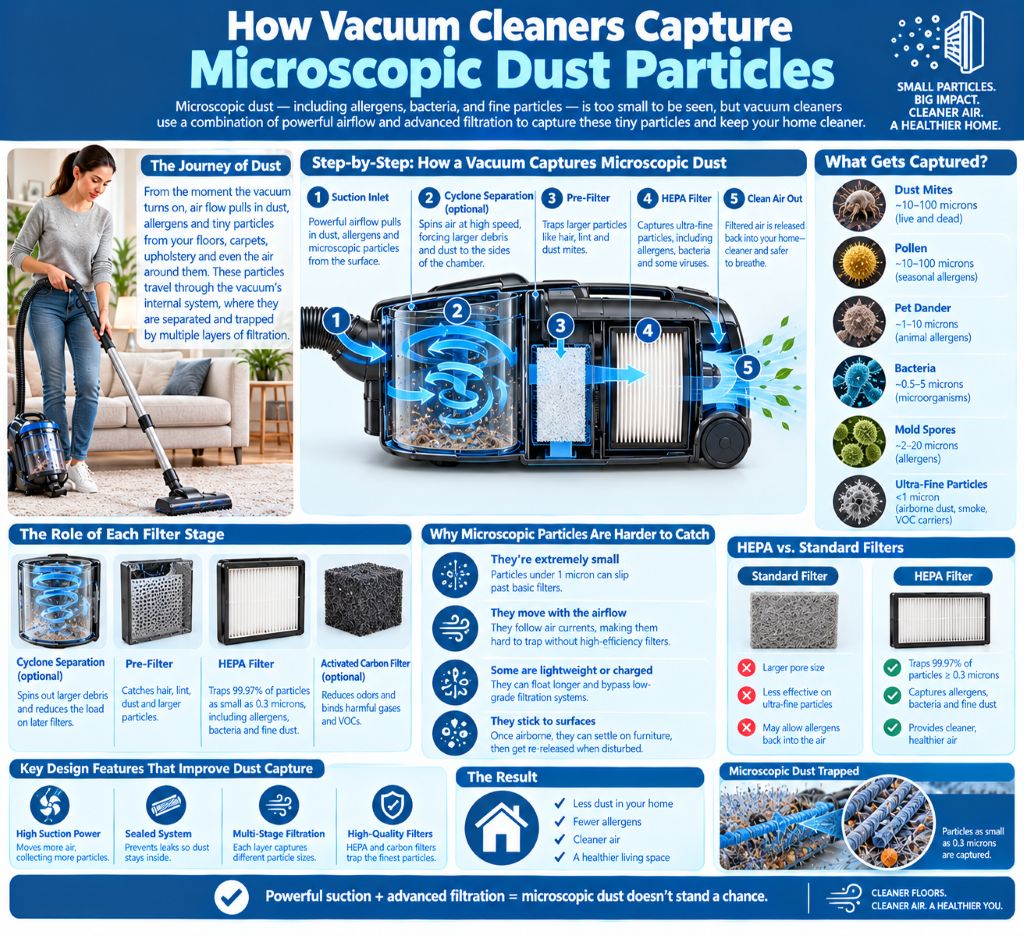
Dust looks like a fine, uniform haze to the naked eye. However, it contains particles of wildly different sizes. A vacuum must catch all of them using different physical tricks. Drawing on performance benchmarks and filtration research from //bestvacuumcleaner.us/, this guide explains how filters actually trap microscopic dust. You will understand why filter design matters more than raw suction alone.
Why Filters Are Not Simple Sieves
Many people imagine a filter working like a kitchen strainer. Large particles get blocked, and small ones pass through the holes. However, this mental picture does not match how fine dust filtration actually works.
According to Wikipedia, the gaps between HEPA filter fibers are typically much larger than the 0.3-micron particles the filter is rated to catch. If filtration worked purely by size, particles this small should pass straight through the visible gaps.
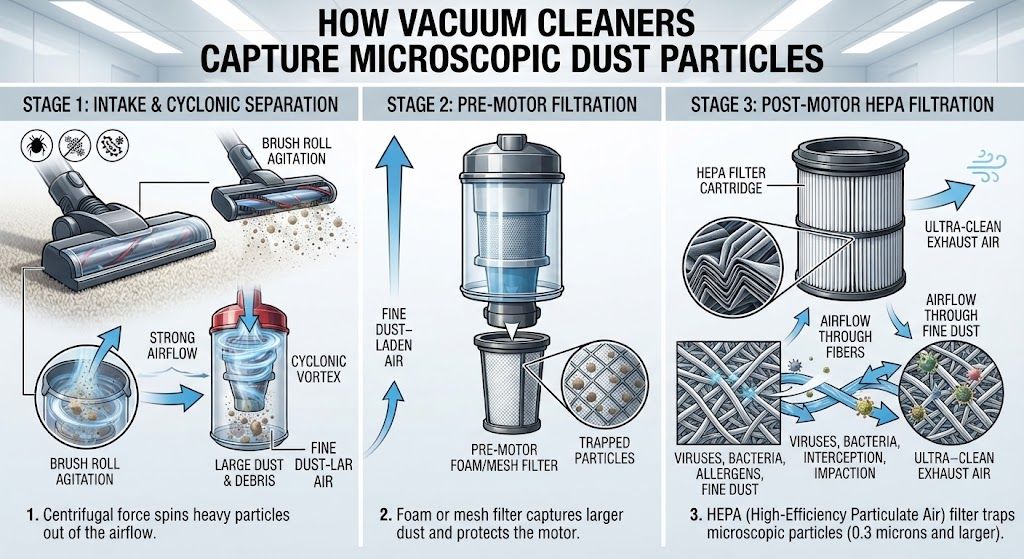
Sylvane explains the real mechanism clearly. A HEPA filter //bestvacuumcleaner.us/vacuum-cleaner/hepa-filter-vacuum-benefits-for-allergies/ does not work like a sieve that captures particles above a certain size while letting smaller ones through. Instead, particles are trapped because they physically stick to individual fibers within the filter mat.
This distinction matters because it explains a surprising fact. Very small particles are often captured more effectively than mid-size ones. If filtration relied only on physical blocking, this result would make no sense. Understanding the three main capture mechanisms below explains why it happens.
Explain That Stuff describes the filter material itself as a dense mat of extremely fine glass fibers arranged randomly. This random arrangement, combined with several distinct physical processes, is what allows the filter to catch particles across a huge range of sizes at once.
Diffusion: Catching the Smallest Particles
The tiniest dust particles behave almost like gas molecules themselves. Diffusion is the mechanism responsible for catching them.
Wikipedia explains that particles below roughly 0.1 microns are captured primarily through diffusion. This process happens because the smallest particles constantly collide with surrounding gas molecules in the air. These collisions knock the particles off any straight path they might otherwise follow.
Sylvane compares this movement directly to Brownian motion, a well-known physics concept. The particles do not travel in predictable lines. Instead, they bounce and wander randomly through the airstream in an erratic, unpredictable pattern.
This randomness actually works in the filter’s favor. Explain That Stuff notes that this erratic wandering increases the odds that a tiny particle will eventually crash into a fiber and stick. The particle essentially bumps its way into capture rather than being blocked by a barrier.
An important detail sets diffusion apart from the other mechanisms. Wikipedia states that diffusion becomes the dominant capture method specifically at lower airflow speeds. When air moves through the filter more slowly, particles have more time to wander and collide with fibers. Therefore, filter design and airflow speed both influence how well diffusion performs.
Interception: Catching Mid-Size Particles
Mid-size particles behave differently than the smallest ones. They tend to follow the airstream more predictably, which calls for a different capture method.
Wikipedia describes interception as occurring when particles follow a line of flow within the moving air. As these particles travel along the airstream, some pass close enough to a fiber that they touch it directly and stick. The key requirement is proximity within about one particle radius of a fiber’s surface.
Sylvane explains this process from the particle’s perspective. As particles follow the airflow through the filter, some pass within one particle diameter of a fiber and become intercepted. Unlike diffusion, this process does not rely on random, chaotic movement.
A filtration expert writing for Texas Air Filters adds a molecular explanation for why particles stick once they make contact. Both particles and filter fibers carry small electrical charges. This creates a natural attraction described by van der Waals forces. As a result, particles adhere firmly once interception brings them close enough to a fiber.
According to this same source, interception plays an especially large role in overall filtration. It accounts for roughly 30 to 40 percent of all particles removed by a typical filter. This makes it one of the most significant capture mechanisms across the full range of particle sizes.
Impaction: Catching Larger Particles
Larger particles present the opposite challenge from tiny ones. Instead of wandering randomly, they carry too much momentum to change direction easily.
Wikipedia explains that larger particles cannot follow the curving contours of the airstream as it bends around individual fibers. Their own inertia keeps them moving in a relatively straight line. As a result, they end up crashing directly into a fiber rather than flowing around it.
A filter manufacturer, Bullard, describes this process in similar terms. Impaction occurs when particles leave their streamline path due to inertia and become trapped directly against a fiber. Once contact happens, attractive forces hold the particle in place against the fiber’s surface.
Airflow speed affects impaction in the opposite way it affects diffusion. Wikipedia notes that this effect increases with higher airflow velocity and with tighter spacing between individual fibers. Faster-moving air gives larger particles even less opportunity to curve around an obstacle in their path.
Wikipedia also clarifies where impaction and interception work best together. Both mechanisms predominate for particles larger than about 0.4 microns. Therefore, larger dust, pollen, and debris rely mainly on these two mechanisms rather than on diffusion.
The Hardest Particle Size to Catch
Not every particle size is equally easy to filter. A specific, troublesome middle ground exists between the mechanisms described above.
Wikipedia identifies this weak point directly. Near a diameter of about 0.21 microns, known as the most penetrating particle size, both diffusion and interception become comparatively less efficient at the same time. This size sits in an awkward gap between the two dominant capture zones.
This explains an important industry practice. Because this size range represents the filter’s weakest performance point, Wikipedia notes that HEPA testing standards specifically measure retention near this range, generally rounded to 0.3 microns for testing purposes. A filter that performs well here reliably performs even better on particles both larger and smaller.
This detail also clears up a common misunderstanding about viruses. Jim Rosenthal, writing for Texas Air Filters, directly addresses a frequently repeated claim that HEPA filters cannot catch particles smaller than 0.3 microns. He states this claim is incorrect, explaining that HEPA filters actually remove over 99 percent of particles even smaller than this size, thanks to diffusion.
Wikipedia’s own overview supports this same point. It confirms that HEPA filters are capable of capturing some viruses and bacteria measuring 0.3 microns or smaller. Therefore, the 0.3-micron test size represents a worst-case benchmark rather than a hard limit on what the filter can catch.
A Fourth Mechanism: Electrostatic Attraction
Beyond the three primary physical mechanisms, some filtration relies on an additional electrical effect. This mechanism works alongside the others rather than replacing them.
Wikipedia lists electrostatic attraction as one of four primary particle collection mechanisms in modern filter design, alongside diffusion, interception, and impaction. This process uses natural electrical charges to pull particles toward fibers even without direct physical contact along the airstream.
Sylvane confirms that particles are also collected through electrostatic attraction within HEPA filtration systems. Some filter materials are specifically engineered or treated to enhance this electrical charge. This addition can improve overall capture efficiency, particularly for certain particle types.
Bullard adds a related, simpler factor to the list as well. Gravity can cause some particles to settle downward, which brings them closer to a fiber’s surface and increases the chance of capture through one of the other mechanisms. While gravity plays a smaller role than the primary three mechanisms, it still contributes to overall performance.
Together, these combined mechanisms explain why well-designed filters achieve such high capture rates. No single physical process could handle the enormous range of particle sizes found in ordinary household dust. Instead, several mechanisms work simultaneously, each specializing in a different part of that size range.
What This Means for Vacuum Performance
Understanding these mechanisms helps explain real differences in vacuum filtration performance. Design choices directly affect how well each mechanism functions.
- Slower airflow through the filter favors diffusion for tiny particles
- Denser fiber packing improves both interception and impaction rates
- A larger filter surface area allows more total collision opportunities
- Sealed housing construction ensures air actually passes through the fiber mat
- Clean, unclogged filters maintain the airflow balance these mechanisms need
A clogged or poorly maintained filter disrupts this balance significantly. If debris blocks normal airflow, air may find alternate paths around the intended fiber mat instead of through it. Therefore, regular filter maintenance protects not just suction power, but the actual physics of particle capture itself.
Filter quality claims should also be read with this science in mind. A true HEPA rating specifically confirms performance at the hardest-to-catch particle size. Therefore, this rating serves as a reliable proxy for overall filtration quality across the full range of particle sizes your vacuum will encounter.
Conclusion
Vacuum filters capture microscopic dust through several distinct physical processes working together. Diffusion catches the tiniest particles through random, bouncing motion. Interception and impaction handle larger particles that travel more predictably through the airstream. Electrostatic attraction and gravity add further support to this combined system. For everyday cleaning in compact homes, choosing a practical model also matters, so learn how to pick a lightweight cordless vacuum for small spaces based on your cleaning needs.
Understanding these mechanisms explains why HEPA-rated filters perform so well across such a wide range of particle sizes. Choose a vacuum with genuine HEPA filtration and keep it well maintained for the best results. Check your current filter’s rating and condition today to make sure these mechanisms can work as designed.
Frequently Asked Questions
Do HEPA filters work like a strainer that blocks particles by size?
No, particles stick to individual fibers through diffusion, interception, and impaction. The filter does not simply block particles by physical size.
What is the hardest particle size for a filter to catch?
Around 0.3 microns, known as the most penetrating particle size. Both diffusion and interception are weakest in this range.
Can HEPA filters really catch particles smaller than 0.3 microns?
Yes, diffusion effectively captures particles even smaller than 0.3 microns. The 0.3-micron rating represents a worst-case test standard.
Why does slower airflow help capture tiny dust particles?
Slower airflow gives small particles more time to wander randomly and collide with fibers through diffusion.
Does a clogged filter affect these capture mechanisms?
Yes, clogging disrupts normal airflow patterns. This can reduce how effectively all capture mechanisms work together.