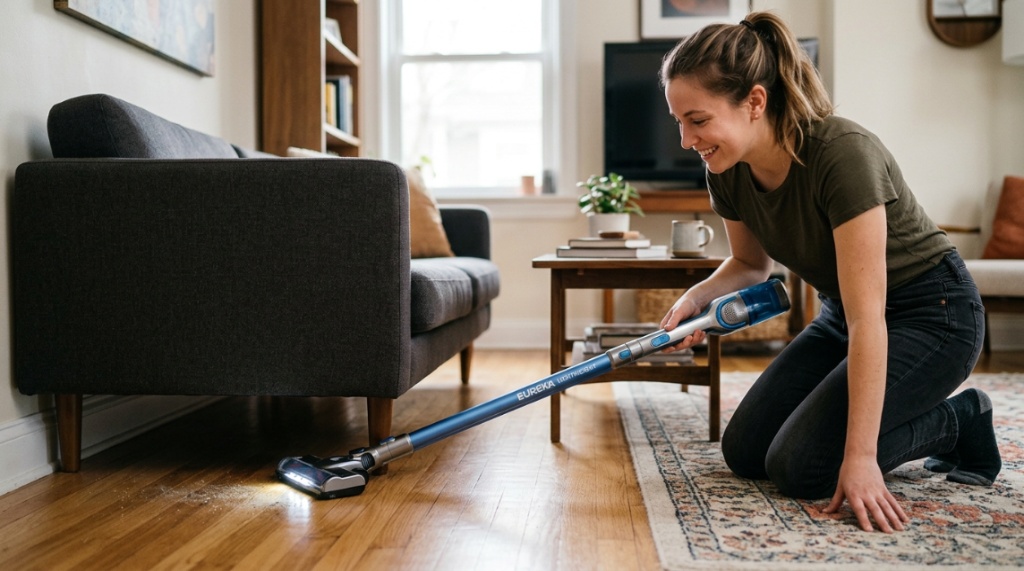
Living in a small apartment or condo often means wrestling with bulky cleaning equipment that takes up precious closet real estate. You know the drill—dragging out a heavy, corded machine with a hose that kinks and a body that barely fits under the sofa. It’s frustrating, and honestly, it makes you avoid cleaning altogether. The solution? A lightweight cordless vacuum small spaces are designed to handle. These compact powerhouses offer the convenience of instant grab-and-go cleaning without sacrificing suction power. This guide cuts through the marketing noise to help you pick the perfect model based on your actual floor type, storage constraints, and cleaning habits, ensuring you get a device that makes tidying up feel effortless.
Whether you are dealing with pet hair on a rug or crumbs on a hardwood floor, the right stick vacuum can revolutionize your routine. We’ll break down the critical specs—like battery life, weight, and bin capacity—in plain English. You’ll learn exactly what to look for and what to avoid, so you can make a confident purchase that fits your lifestyle and budget. Let’s dive into the details that actually matter.
What Makes a Vacuum “Lightweight” and Why Does It Matter?
A lightweight vacuum typically weighs under 6 pounds, making it easy to maneuver with one hand. This is crucial in small spaces because you often need to lift the unit to clean stairs, high shelves, or awkward corners. Heavier models cause wrist fatigue and make you less likely to clean regularly.
The weight factor isn’t just about comfort; it’s about practicality. In a small apartment, you might store the vacuum on a hook or in a narrow gap. A lighter unit is easier to mount and retrieve. Furthermore, when you are moving around tight furniture layouts, the ability to pivot and lift the vacuum without strain means you’ll actually reach those dust bunnies that collect under radiators and behind doors.
The Ideal Weight Range for Apartments
Look for vacuums in the 4.5 to 5.5-pound range for the best balance of power and portability. Models under 4 pounds exist, but they often sacrifice suction or battery capacity. A middle-ground weight ensures the motor has enough power to pick up embedded dirt while remaining comfortable to carry.
Why Heavy Vacuums Are Overkill
Traditional upright vacuums can weigh 15-20 pounds. In a 600-square-foot apartment, you simply don’t need that much motor capacity. The extra weight provides no benefit when cleaning small, open areas. It just makes the chore harder and storage more complicated.
Balancing Weight with Suction Power
Don’t assume light means weak. Modern brushless motors generate impressive suction in compact frames. Check the air watts (AW) or Pascal (Pa) rating. Aim for at least 100 AW for hard floors and 150 AW if you have low-pile carpets that need deeper agitation.
Which Battery Type Offers the Best Runtime for Quick Cleanups?

Lithium-ion batteries are the standard, offering consistent power until they die. For a small space, you don’t need a 60-minute runtime; 20-30 minutes is often more than enough. This shorter runtime allows for a lighter battery, which reduces the overall weight of the machine.
Think about your habits. Do you clean in 5-minute bursts or 30-minute sessions? Most small-space dwellers prefer frequent, quick passes over the floor. A vacuum with a 25-minute runtime will cover a 1,000-square-foot apartment on a single charge if you are moving efficiently. However, the “Max” or “Boost” mode drains the battery twice as fast, so factor that into your expectations.
Removable vs. Built-in Batteries
Removable batteries are a game-changer. You can charge one while using the other, effectively giving you unlimited runtime. They also extend the lifespan of the vacuum, as you only replace the battery pack rather than the entire machine after a few years of degradation.
Estimating Clean Time per Charge
As a rule of thumb, double the estimated battery life to get the actual cleaning time in “Eco” mode. If a manufacturer claims 40 minutes, you’ll likely get around 20 minutes in standard mode. For small spaces, prioritize a standard mode that lasts at least 18 minutes to avoid mid-clean dead batteries.
Charging Time and Storage
Consider how long it takes to recharge. A 3.5-hour charge time is standard. If you have a wall-mounted dock, ensure the vacuum slots in easily without taking up too much visual space. The charging cradle should be near an outlet but out of the main walkway.
How Do I Choose the Right Attachment Tools for My Floor Plan?
You need a crevice tool and a motorized floor head. A mini motorized brush is a bonus for upholstery. Avoid vacuums with dozens of plastic accessories that end up in a drawer—they add cost and complexity without adding value in a small home.
Your floor type dictates the floor head. If you have all hardwoods, a soft roller head is perfect. It grabs debris directly without scattering it. For area rugs, you need a brush roll with bristles to agitate the fibers. Some models offer a combo head that works on both, which is ideal for renters who have mixed flooring.
Motorized Brush Roll vs. Soft Roller
A motorized brush roll is necessary for carpets to loosen pet hair and dust. A soft roller is better for hard floors because it prevents scratching and has a “vacuuming and wiping” effect. If you have 80% hard floors, prioritize the soft roller and use a separate stick tool for rugs.
Must-Have Crevice and Upholstery Tools
Look for a 2-in-1 tool that combines a brush and a crevice nozzle. This saves space. The tool should be able to reach baseboards and tight corners between cabinets. For upholstery, a mini motorized brush is far more effective than a simple suction-only nozzle at removing embedded pet hair from sofas.
Storing Attachments Onboard
Ensure the vacuum has a clip or slot to store the crevice tool directly on the wand. If the tools are not stored on the unit, you will lose them. In a small space, clutter is the enemy, so integrated tool storage is a non-negotiable feature.
Can a Cordless Vacuum Really Replace a Traditional Upright?
Yes, for most small-space households, a cordless stick vacuum can be your primary cleaner. They offer sufficient suction and incredible convenience. However, they require more frequent bin emptying and diligent battery maintenance compared to corded models.
The shift is largely psychological. With a cordless unit, you remove the friction of plugging and unplugging. You see a crumb, you grab the vacuum, you fix it in ten seconds. This frequency of use often leads to a cleaner home overall, even if the deep-cleaning capacity is slightly lower than a heavy upright.
Suction Power Comparisons
Modern high-end cordless vacuums deliver suction comparable to older corded models. The key is the Cyclone separation technology that prevents clogs. Look for a vacuum with a multi-cyclonic filter system to maintain peak suction until the bin is full.
The Trade-off: Bin Capacity
Small bins (0.2 to 0.5 liters) are the main drawback. You will empty the bin frequently. This is not a huge issue if you are cleaning small areas, but it can be annoying. Look for a model with a quick-release, one-touch empty mechanism to minimize contact with dust.
Long-Term Maintenance Costs
You will need to replace filters every 3-6 months and potentially batteries every 2 years. Factor these costs into your decision. Some budget models have expensive proprietary batteries, while others use standard packs. Check the price of replacement parts before you buy.
What Is the Best Way to Store a Cordless Stick Vacuum?
Mount it on a wall bracket or tuck it into a shallow closet. Wall mounting keeps it accessible and charges it simultaneously. This eliminates the need for floor space, which is precious in a small apartment.
The leaning method is popular, but it can scratch walls and the vacuum can fall over. A dedicated dock is better. If you have no wall space, consider a freestanding charging tower that has a small footprint, or simply lay the vacuum flat in a deep drawer if it folds down.
Wall-Mounted Docking Stations
Drill the bracket into a stud or use heavy-duty drywall anchors. Place it near your kitchen or entryway—the areas where you clean most. The dock keeps the vacuum charged and the tools organized. It turns the vacuum into a “grab-and-go” utensil rather than a bulky appliance.
Folding Wands for Tight Gaps
Some vacuums, like certain models from Shark and Tineco, feature a folding mechanism that allows the vacuum to bend in half. This makes it easy to slide under low furniture or store in a low-profile box. This is a fantastic feature if you have very low clearance beds or sofas.
Leaning vs. Hanging Risks
While leaning seems easy, it puts stress on the battery connection point. It also risks the vacuum falling and cracking the bin. Always prefer a dock or a flat storage position. Consider a corner floor stand if drilling isn’t an option—just ensure it has a weighted base to prevent tipping.
How Much Should I Spend on a Compact Vacuum?
You can get an excellent lightweight cordless vacuum for $200-$400. Budget models under $150 often lack suction or battery life. Premium models over $600 offer marginal gains that small-space users may not need.
Focus your budget on the battery and motor quality. Expensive “smart” features, like LCD screens and app connectivity, are unnecessary. Put your money into a proven motor brand (like those from Dyson, LG, or Samsung) and a reputable battery cell. A mid-range model from a known brand will outperform a high-end model from a non-specialist.
Identifying the “Sweet Spot” for Value
The price range of $250-$350 typically offers the best balance of features. In this tier, you get removable batteries, HEPA filters, and adequate suction. You also get better build quality that doesn’t creak or crack.
Avoiding False Economy in Budget Models
That $99 vacuum might seem appealing, but the battery health will degrade within a year. If the battery is embedded, you’ll have to replace the whole unit. Spending slightly more upfront saves money in the long run. Consider the cost-per-year of ownership rather than the sticker price.
Considering Refurbished and Previous Models
Don’t overlook refurbished units from the manufacturer. They often carry the same warranty as new models but at a discount. Similarly, when a new model is released, the previous generation often drops in price significantly while offering nearly identical performance. This is a great way to get a premium vacuum for a budget price.
Which Floor Types Are Cordless Vacuums Best Suited For?
Cordless vacuums excel on hard floors and low-pile carpets. They struggle slightly with high-pile shag carpets because the smaller brush rolls lack the torque to deep-clean thick fibers. For small homes, these limitations are rarely a problem.
If you have tile, hardwood, or laminate, a cordless vacuum is perfect. The direct suction power works efficiently on smooth surfaces. For area rugs, just use the appropriate power mode. Let’s look at specific scenarios.
Optimizing for Hardwood and Tile
Use the hard floor mode (if available) to stop the brush roll from spinning. This prevents scattering debris and prevents the brush from flinging sand against your baseboards. The suction alone is strong enough to lift particles directly into the bin.
Managing Area Rugs and Low-Pile Carpets
Engage the brush roll for rugs. Do a few slow passes to allow the brush to agitate the fibers. You may need to empty the bin more often when vacuuming rugs, as they release more dust and dirt than hard floors.
Dealing with Pet Hair and Allergens
Look for a vacuum with a HEPA filter to trap allergens. For pet hair, the motorized brush roll is essential. However, hair can wrap around the brush. Look for a model with “anti-tangle” technology, which uses a comb to strip hair off the brush as it spins, preventing manual cleaning with scissors.
Why Is a HEPA Filter Important in a Small Space?
A HEPA filter traps microscopic particles like dust mites and pollen, preventing them from being blown back into the air. In a small apartment, the air has less volume to dilute pollutants, making air quality a more significant concern. Sealed HEPA filtration ensures the vacuum doesn’t contribute to indoor air pollution.
Cheaper vacuums often have “HEPA-type” filters which are not certified. A true HEPA filter captures 99.97% of particles at 0.3 microns. This is vital for allergy sufferers. When the filter is on the exhaust (back of the vacuum), it cleans the air coming out. If it is just on the motor (pre-motor filter), it only protects the motor, not your lungs.
Understanding True HEPA vs. HEPA-Type
Check the packaging for the specific “HEPA” certification. “HEPA-like” or “HEPA-type” are marketing terms that do not meet the same standard. Look for words like “True HEPA” or “Certified HEPA.” Also, check if the entire air path is sealed with gaskets.
Washable vs. Disposable Filters
Washable filters save money and reduce waste. You can rinse them under water and let them dry for 24 hours. However, they degrade over time. Disposable filters are convenient but cost money. Buy two sets of washable filters so you can rotate them while one dries.
Maintaining Clear Airflow
Clogged filters reduce suction and strain the motor. Get into the habit of tapping out the filter dustbin’s pre-filter every time you empty the bin. A deep clean of the HEPA filter should happen monthly. A clean filter improves performance dramatically.
For those living in tight quarters, understanding the balance between price and performance is key. If you’re curious about how different budget models stack up against each other, you can check out this detailed comparison of a lightweight cordless vacuum small spaces specifically reviewed for apartment dwellers. This resource can help you narrow down your options based on real-world testing.
How Loud Are Cordless Vacuums Compared to Corded Ones?
Cordless vacuums are generally quieter, averaging 70-75 decibels, but the sound is higher-pitched. They are inconvenient for cleaning while others are sleeping, but they don’t cause the same low-frequency booming of traditional uprights.
The noise profile matters in apartment buildings. A high-pitched whine can travel through thin walls. If you live in a building with noise restrictions, consider a model with a “quiet mode.” This reduces suction but lowers the decibel level significantly.
Measuring Decibel Levels
Look up the decibel (dB) rating online. A difference of 10 dB is perceived as twice as loud. A vacuum at 80 dB is much harsher than one at 70dB. While you don’t want to sacrifice power for silence, being aware of the noise level helps in shared living situations.
Why High-Pitched Sounds Travel Further
The small, high-speed motors in stick vacuums create a lot of turbulence, which sounds like a whine. This sound is more directional than the low hum of a motor. Point the vacuum away from shared walls to minimize disturbance to your neighbors.
What Features Should I Ignore to Save Money?
Skip the Wi-Fi connectivity, touchscreen displays, and laser lights. These features inflate the price without improving cleaning effectiveness. Stick to the basics: good suction, decent battery, and a washable filter. The added bells and whistles are unnecessary in a device you’ll use for 10 minutes a day.
Focus on the engineering, not the gimmicks. The laser lights are helpful for spotting dust, but a simple LED light on the floor head is just as effective for seeing under the sofa. The “smart” sensors that adjust suction power automatically are a convenience, but they add a point of failure to the machine.
The Motor is the Core Investment
Invest in a vacuum with a well-reviewed digital motor. Brands like Dyson and LG have invested heavily in motor efficiency. A 150,000 RPM motor spins the brush roll faster and creates stronger suction without draining the battery faster than a less efficient motor.
Simple LED Lights vs. Lasers
LED lights are cheap to manufacture and great for illuminating dark corners. Lasers (like the ones on Dyson V15) are excellent but require precise engineering to avoid eye damage. For a small space, a standard LED light is perfectly adequate and much cheaper to replace. Before upgrading to a compact model, ensure your current cleaning tool is running efficiently. If you notice strange noises while operating your device, understanding why your vacuum makes a quick pfft sound can help you troubleshoot suction issues quickly.
Frequently Asked Questions
Can I use a lightweight cordless vacuum on high ceilings or curtains?
Yes, this is a major advantage. The lightweight body and extended wand allow you to reach ceiling corners and curtain rods without standing on a chair. The compact nature makes it easy to use with a step stool safely.
How often do I need to charge a cordless vacuum?
It depends on usage, but generally, charge it when the battery indicator shows less than 20%. Avoid leaving it on the charger for weeks at a time if the battery is removable. For daily spot cleaning, you might only need to charge it twice a week.
Is it safe to vacuum liquids with these models?
No. Standard cordless vacuums are dry-only. Do not attempt to vacuum up water or wet spills. This will ruin the motor and void the warranty. You would need a specific wet/dry vacuum model for that purpose.
What is the lifespan of a cordless stick vacuum?
With proper care, expect 3-5 years of life. The main components to watch are the battery and the filters. If you replace the battery and keep the filters clean, the motor should last much longer. High-end models can last over 8 years with parts replacement.
How do I clean the brush roll of a cordless vacuum?
Most models allow you to click the brush roll out. Use a pair of scissors or a seam ripper to cut wrapped hair. Wipe the roll with a damp cloth. Clean it monthly to maintain agitation efficiency, especially in homes with pets.
Can a cordless vacuum replace a robot vacuum?
They serve different purposes. A robot vacuum maintains floors daily automatically, while a cordless stick is for immediate spot cleaning and deeper dirty spots. Many small-space residents use both, but if you have to choose, the cordless stick is more versatile.
Why is my cordless vacuum losing suction?
Check three things in order: Is the bin full? Is the filter clogged? Is there a blockage in the wand or floor head? Usually, one of these three is the culprit. Emptying the bin and cleaning the filter should resolve 95% of suction issues.
Conclusion
Choosing the right lightweight cordless vacuum for your small space is about balancing physics and habit. You now know the critical factors: weight under 6 pounds, a swappable battery for longevity, and a compact storage solution. You don’t need top-of-the-line wattage or smart features; you need a reliable tool that puts convenience first. The best vacuum is the one you aren’t afraid to pick up several times a day, and a cordless stick fits that bill perfectly.
Take this guide with you while you shop. Filter out the marketing fluff regarding “lasers” and “apps,” and focus on the HEPA filtration and ease of bin emptying. Make the decision that cleans your home and simplifies your life. You’ve done the research—now go find the unit that will make your daily cleaning a breeze. Your floors, and your back, will thank you.