You know the feeling. You’re standing in the gardening aisle, staring at a wall of lawn mowers, and the price tags are enough to make your wallet wince. You want to ditch the gas can, the pull cords, and the noisy fumes, but you’re convinced that switching to battery power means breaking the bank. It is a common dilemma: how do you find an affordable cordless lawn mower that actually cuts well, lasts long enough to finish your yard, and doesn’t fall apart after a single season
The good news is that the era of the underpowered, budget-friendly electric mower is largely over. Battery technology has advanced rapidly, forcing even premium brands to compete at lower price points. This guide cuts through the marketing noise to show you exactly what to look for, which features matter most, and where you can find a model that offers serious performance without the premium price tag. We’ll break down the specs that matter, the trade-offs you should accept, and how to make a smart purchase you won’t regret in the spring.
Key Takeaways
- Prioritize Amp Hours (Ah) over Voltage: The battery’s capacity (Ah) determines runtime more than the voltage. Look for at least 4.0Ah to ensure you can finish a standard suburban lot.
- Accept Plastic Decks at Lower Prices: To save money, you’ll likely get a composite or plastic deck. This is fine for most homeowners as long as it has a steel blade adapter and a strong motor.
- Check the “Push” vs. “Self-Propelled” Split: You can save $100–$200 by choosing a manual push model if your yard is flat and under a quarter-acre.
- Look Beyond the Mower for Value: Buying into a battery platform (like EGO or Ryobi) means you can use the same batteries for leaf blowers and trimmers, increasing the overall value.
- Read Reviews for “Bagging” Performance: The most common complaint with budget cordless mowers is poor mulching or bagging. Look for mowers with high-lift blades or “mulch-on-demand” features.
Defining “Affordable” vs. “Cheap”
Before you start shopping, it is critical to distinguish between a mower that is inexpensive and one that is cheaply made. An “affordable” mower offers the best dollar-to-performance ratio. A “cheap” mower might cost $150, but it often has a weak motor that bogs down in thick grass, a battery that dies after 15 minutes, and a flimsy deck that rusts or cracks.
In the current market, the “sweet spot” for affordability usually sits between $250 and $400. In this range, you are paying for proven technology rather than paying for brand prestige. If you are willing to look at refurbished models or previous-generation stock, you can sometimes find machines that originally retailed for $500+ for under $350. These models often feature brushless motors and larger decks that you won’t find on the absolute lowest-tier models.
The $200 Trap
Mowers priced under $200 often fall into the “disposable” category. They usually feature brushed motors (less efficient, shorter lifespan) and 2.0Ah batteries. While they are fine for very small lawns (under 1,500 sq ft), they struggle with damp grass and often require a second charge to finish the job. Check the weight of these units; if the mower itself is exceptionally light, it might have a plastic frame that can’t handle the torque of cutting thick St. Augustine or Fescue.
Key Features That Determine Real Performance
To ensure you get a great-performing machine, you need to look past the shiny exterior and check the internal components. Here is the checklist of specifications that separate a workhorse from a toy.
Brushless Motor vs. Brushed Motor
This is the single most important factor for long-term performance. Brushless motors are more efficient, generate less heat, and offer significantly more torque than traditional brushed motors. They also extend battery runtime by up to 30-50%. While a brushed motor might be cheaper, it is the #1 reason budget mowers fail under heavy load. If you see “brushless” on the box, you are looking at a unit designed to last.
Battery Capacity (Ah) and Voltage (V)
Manufacturers love to advertise 40V or 60V, but voltage simply indicates the power available. The Amp Hour (Ah) rating tells you how long the battery can sustain that power output. Most affordable mowers come with a 2.5Ah or 4.0Ah battery. For a standard 1/4-acre lot, you need at least a 4.0Ah battery to finish comfortably without “range anxiety.”
Another hidden factor is charging time. A “rapid charger” can fill a battery in 45 minutes, whereas a standard charger might take 2-3 hours. If you only have one battery, a rapid charger is an essential feature to look for.
19-Inch vs. 21-Inch Cutting Decks
A 19-inch deck is lighter and easier to maneuver, but it requires more passes to cover the same area. A 21-inch deck is the gold standard for a standard home; it tracks close to gas-powered mower widths. However, with an affordable electric mower, a wider deck means more load on the motor. Ensure the 21-inch model you are eyeing has a brushless motor, or it will struggle to mulch if the grass is slightly damp.
When you are ready to look at specific models that meet these criteria, you should check out this detailed guide on an affordable cordless lawn mower that has already been tested for durability and real-world cutting power. It highlights how specific models handle the transition between battery zones without losing power.
Push vs. Self-Propelled: A Major Price Split
Self-propelled mowers are fantastic—until you look at the price. The transmission system (the gears that drive the wheels) adds significant cost and weight to the mower. If you have a flat, open yard, saving money by buying a push mower is the smartest choice.
However, it is vital to read the reviews regarding the weight of the mower. Cordless mowers are inherently heavy because of the battery and motor. A 21-inch steel-deck push mower can weigh between 50 and 60 pounds. While pushing it on flat ground is easy, moving it up a slope or through thick grass will be a workout. If you have any incline, consider whether the extra $100 for a rear-wheel-drive self-propelled model is worth saving your back.
Single Lever Height Adjustment
This is a “quality of life” feature that often gets cut on budget models. Older cheap mowers require you to adjust each wheel individually with a lever and a spring pin. This is frustrating and time-consuming. Look for a mower with a single-point central height adjustment. It allows you to change the cutting height in seconds, encouraging you to cut higher during hot summer months (which is better for the grass root system).
Where to Shop for the Best Deals
The retail landscape for outdoor power equipment has changed. You no longer have to go to a big-box hardware store to get a good deal. here are the best places to find high-performance models at reduced prices,For related home maintenance tips, check out our guide on why does my vacuum make a quick ‘pfft’ sound.
Big Box Retailers (Home Depot & Lowes)
These stores have exclusive color schemes and model numbers for brands like Ryobi, EGO, and Craftsman. The benefit here is the ability to see the mower in person and test the ergonomics. The downside is that they only carry the newest models. At the end of the season (August–October), these stores often discount floor models significantly.
Online Marketplaces (Amazon & Walmart)
You often get the lowest “everyday” price here. More importantly, online retailers show you user-generated photos of the mower with actual grass clippings and bagging results. Look for “open box” or “renewed” options on Amazon, which can reduce the price by 15–20%. Just be careful with third-party sellers; ensure the warranty is honored by the manufacturer (like EGO’s 5-year warranty), not the seller.
Direct from Manufacturer Outlets
Brands like Greenworks and Ryobi have outlet stores on eBay. These are often refurbished units or models with cosmetic blemishes (like a scratched handle). These cosmetic issues rarely affect performance. Buying a factory-refurbished unit directly from the brand is one of the best ways to get a premium mower (with a brushless motor) for the price of a budget unit.
Evaluating Cutting Performance: Mulching vs. Bagging
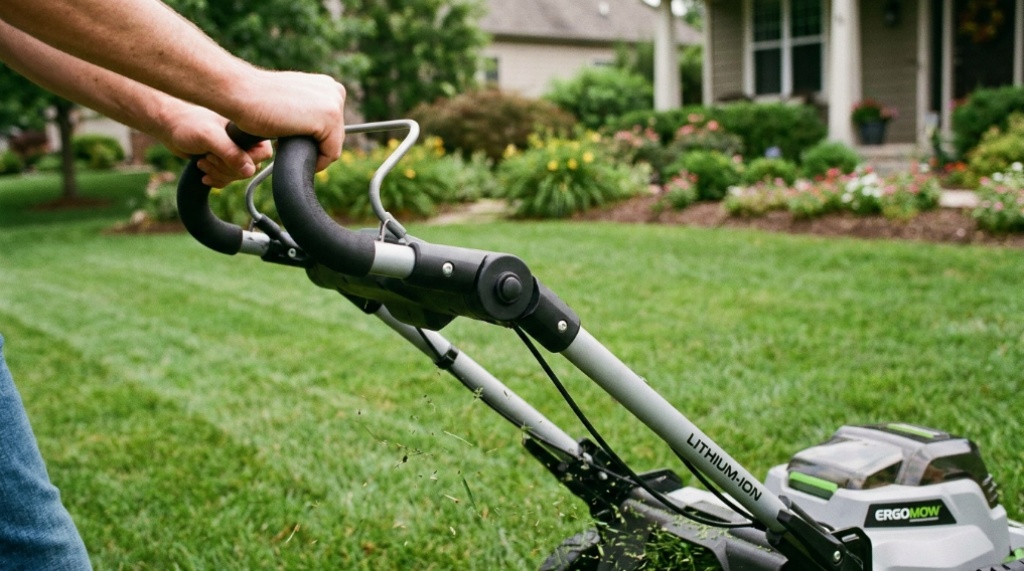 Performance isn’t just about power; it’s about how the mower handles the grass after it cuts it. Most complaints about budget mowers are related to clogging and poor grass distribution.
Mulching Capability
If you plan to return nutrients to the soil, you need a mower with a dedicated mulching blade (usually a “baffle” under the deck). Budget mowers often lack sufficient airflow to keep the grass suspended for fine cutting. Look for reviews that specifically mention “mulches well without clumping.” You will likely need to cut more frequently when using a budget mulching mower because they cannot handle long, wet grass as effectively as high-end models.
The Bagging Problem
Many entry-level mowers struggle to blow grass into the bag. This is often due to a poorly designed chute or a fan blade that doesn’t create enough lift. Check the bag indicator feature. If a mower has a “full bag indicator” or a “high-lift” blade option, it usually indicates the manufacturer has invested in the airflow design, which directly translates to better bagging performance.
| Feature | Budget (Under $250) | Mid-Range ($250–$400) |
|---|---|---|
| Motor Type | Usually Brushed | Usually Brushless |
| Battery Included | 2.0Ah–2.5Ah | 4.0Ah–5.0Ah |
| Deck Material | Thin Plastic/Stamped Steel | Reinforced Polymer/Steel |
| Best For | Small city lots, flat terrain | Suburban 1/4-acre lots, slight slopes |
| Drive Type | Push only | Push and Self-Propelled options |
Long-Term Ownership and Battery Replacement
One of the hidden costs of cordless mowers is battery replacement. Lithium-ion batteries degrade over time, usually lasting 3 to 5 years depending on storage. Before buying an obscure brand, verify that the battery is compatible with other tools in that ecosystem (e.g., a trimmer or blower).
Investing in a well-known platform (like EGO, Ryobi, or Milwaukee) means that if your mower battery dies, you can simply swap it with the one from your leaf blower. Buying a “no-name” brand locks you into a proprietary battery that may be discontinued in a few years, forcing you to buy a whole new mower.
Storage Considerations
Storing the mower upright is crucial for saving space, but battery-powered mowers are front-heavy. Ensure the handlebar assembly locks securely in multiple positions. Also, look for a “storage lock” on the handle to prevent it from collapsing and hitting the battery while hung on a wall hook.
Common Mistakes to Avoid When Buying
Making a purchase is easy, but making the right purchase requires avoiding a few common pitfalls.
- Ignoring the Manual: Many performance issues arise from user error regarding height settings. Running a mower too low in summer scalps the grass and makes the motor work harder. Always set the deck to 3-4 inches in hot weather.
- Cutting Wet Grass: No budget mower handles wet grass well. The wet clippings clump under the deck and destroy battery life due to increased motor resistance.
- Not Checking the Blade: Stock blades on budget mowers are often thin. Replacing the blade with a high-lift aftermarket blade (costing ~$20) can significantly improve bagging performance and turn a mediocre mower into a great one.
Frequently Asked Questions
How long does a battery last on an affordable cordless lawn mower?
On average, a single charge with a 4.0Ah battery will run for 30 to 45 minutes. This is usually sufficient for a 1/4-acre lawn. The runtime decreases significantly when mulching thick, tall, or damp grass because the motor draws more power.
Can I use a third-party battery to save money?
It is not recommended. Third-party batteries often lack the thermal sensors and battery management systems (BMS) of OEM (Original Equipment Manufacturer) batteries. Using them can void your warranty and risk damaging the mower’s motor or electronics.
Do cordless mowers need special storage in winter?
Yes. Lithium-ion batteries should be stored indoors at temperatures between 40°F and 70°F. Always store the battery with a partial charge (about 30-50%) if you are not using it for several months. Do not leave it on the charger.
Are cordless mowers as powerful as gas mowers?
In terms of torque, modern brushless motors can deliver cutting force comparable to a gas engine as long as you stay within their limits. However, they lack the “overload” capacity of gas. In thick, wet, or overgrown grass, a gas mower will keep going, whereas an electric mower may stall the blade to protect the motor.
Is a 21-inch deck too heavy to push?
Not necessarily. A standard 21-inch push mower weighs about 40-50 pounds. However, since the weight is distributed unevenly, you should test the handle height to ensure it is ergonomic. If you have a large yard or slopes, step up to a self-propelled model even if it costs more.
Conclusion
Finding the right affordable cordless lawn mower is about balancing immediate cost with long-term utility. The best strategy is to focus on the core components—specifically a brushless motor and a 4.0Ah+ battery—and then cut costs on the peripherals, like choosing a push model over a self-propelled one or accepting a plastic deck.
Do not rush into the cheapest option on the shelf. Take the time to compare the amp-hour ratings and read user reviews regarding bagging performance. By prioritizing these factors over glossy branding, you can secure a mower that keeps your lawn pristine for years to come, allowing you to finally retire your gas can for good. Start your search with reputable brands known for their battery ecosystems, and look for seasonal discounts to maximize your savings.