Making authentic mbeju requires understanding the delicate balance of cassava starch and other key ingredients. This traditional Paraguayan flatbread has captivated food lovers worldwide, including those who visit Houston Bamboo House to experience authentic South American flavors. The secret to perfect mbeju lies not just in the ingredients themselves, but in getting the ratios exactly right.
Understanding Mbeju and Its Essential Ingredients
Mbeju is a gluten-free flatbread from Paraguay that relies heavily on cassava starch for its distinctive texture. Unlike wheat-based breads, this delicacy uses only a handful of simple components. However, the proportions matter enormously. Getting familiar with mbeju ingredients helps home cooks recreate this centuries-old recipe with confidence.
The base ingredient is cassava starch, also called tapioca starch or almidón de mandioca. This fine white powder comes from the cassava root, a staple crop throughout Latin America. When combined with cheese, fat, and salt, it creates a chewy, satisfying flatbread that’s both simple and remarkable.
The Golden Ratio for Cassava Starch
Traditional recipes call for approximately two cups of cassava starch as the foundation. This measurement serves as your starting point. From there, you’ll add other ingredients in specific proportions to achieve the authentic texture.
The starch must be finely ground and completely dry. Any moisture in the starch will throw off your ratios. Therefore, many experienced cooks recommend sifting the cassava starch before measuring. This ensures accuracy and prevents lumps in the final product.
Most authentic recipes follow this basic framework: for every two cups of cassava starch, use about one cup of shredded cheese. The cheese should be fresh and moist, not aged or dried out. Paraguayan queso fresco works best, though farmers cheese or mozzarella can substitute in a pinch.
Balancing Fat Content for Perfect Texture
Fat plays a crucial role in mbeju preparation. The traditional recipe calls for approximately four tablespoons of melted butter or lard per two cups of starch. This fat content creates the characteristic flakiness that makes mbeju so appealing.
Additionally, the cheese itself contributes fat to the mixture. Fresh cheese typically contains enough moisture and fat to help bind the starch particles together. However, if using a drier cheese variety, you may need to increase the butter slightly.
The fat should be melted but not hot when added to the starch mixture. Hot fat can cook the starch prematurely, creating an uneven texture. Room temperature or slightly warm fat blends more smoothly with the other ingredients.
Liquid Ratios and Milk Considerations
Some recipes include a small amount of milk to adjust consistency. Generally, one to three tablespoons of milk per two cups of starch suffices. The exact amount depends on several factors, including humidity and cheese moisture content.
Start with less liquid and add more if needed. The mixture should resemble coarse crumbs that hold together when squeezed. Too much liquid creates a sticky, unmanageable dough. Conversely, too little liquid results in a crumbly mess that won’t hold its shape.
According to food scientists at the Smithsonian Magazine, cassava starch behaves differently than wheat flour because it lacks gluten. This means the binding depends entirely on the interaction between starch granules, fat, and moisture.
Salt and Seasoning Proportions
Salt enhances flavor without overpowering the delicate taste of cassava. Use approximately one teaspoon of salt per two cups of starch. This amount can be adjusted based on the saltiness of your cheese.
Some cooks add additional seasonings, though traditional mbeju keeps things simple. A pinch of black pepper or a dash of garlic powder can complement the cheese nicely. However, purists prefer letting the natural flavors shine through.
The salt should be fine-grained and evenly distributed throughout the mixture. Coarse salt may not dissolve properly, creating pockets of intense saltiness in the finished flatbread.
Cheese Selection and Quantity
Cheese quality dramatically impacts the final result. Fresh, high-moisture cheese works best for authentic mbeju. The standard ratio calls for one cup of crumbled or shredded cheese per two cups of cassava starch.
Paraguayan queso fresco provides the most authentic flavor profile. This fresh cheese has a mild, slightly salty taste that complements the neutral cassava perfectly. If unavailable, substitute with queso blanco, fresh mozzarella, or farmers cheese.
The cheese should be finely shredded or crumbled before mixing. Large chunks won’t distribute evenly throughout the starch. Moreover, small pieces melt more uniformly during cooking, creating pockets of gooey cheese throughout the flatbread.
Adjusting Ratios for Different Altitudes and Climates
Environmental factors affect how cassava starch behaves. In humid climates, the starch may absorb moisture from the air. Therefore, you might need slightly less liquid in your recipe. Conversely, dry climates may require an extra tablespoon of milk or water.
Altitude also plays a role in cooking times and moisture evaporation. Higher elevations may require slight adjustments to achieve the proper consistency. Start with standard ratios and make notes about necessary modifications for future batches.
Mixing Techniques for Optimal Results
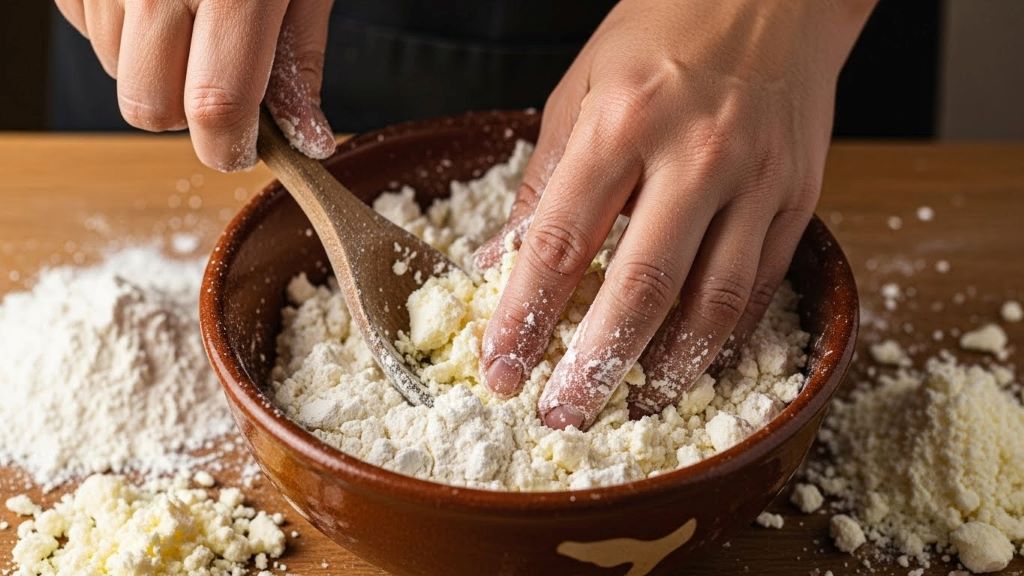
The mixing method matters as much as the ratios themselves. Start by combining the dry cassava starch with salt in a large bowl. Add the melted fat and work it through with your fingers until the mixture resembles coarse breadcrumbs.
Next, incorporate the shredded cheese, distributing it evenly throughout. Finally, add any liquid one tablespoon at a time, mixing gently between additions. The goal is a crumbly mixture that holds together when pressed but isn’t sticky.
Overmixing can make the mbeju tough. Handle the mixture gently and avoid kneading or pressing too aggressively. The light touch preserves the delicate, flaky texture that makes mbeju special.
Cooking Temperature and Timing
Proper cooking brings all those carefully measured ingredients together. Heat a griddle or skillet over medium heat. Too hot, and the outside burns before the inside cooks. Too cool, and the mbeju becomes dense and heavy.
The flatbread typically cooks for three to four minutes per side. You’ll know it’s ready when golden brown spots appear and the edges start to crisp. The interior should remain soft and slightly chewy, with melted cheese pockets throughout.
Scaling Recipes Up or Down
The basic ratios scale linearly for larger or smaller batches. Simply maintain the proportion of two parts starch to one part cheese, with appropriate amounts of fat, salt, and liquid. A half batch uses one cup of starch and half cup of cheese, for instance.
For large gatherings, consider making multiple small batches rather than one enormous batch. Fresh mbeju tastes best, and working with smaller quantities allows better control over texture and consistency.
Common Ratio Mistakes to Avoid
Too much liquid creates sticky, unmanageable dough that spreads too thin during cooking. This results in crispy, cracker-like mbeju rather than the desired soft texture. If this happens, add more cassava starch one tablespoon at a time until the consistency improves.
Insufficient fat makes the mbeju dry and crumbly. The flatbread should have a slight richness from the butter or lard. Don’t skimp on this ingredient, as it’s essential for proper texture and flavor.
Using aged or dry cheese also causes problems. The cheese needs enough moisture to help bind the ingredients. Dry cheese simply won’t integrate properly with the starch, resulting in a mealy, unpleasant texture.
Storage and Reheating Considerations
Leftover mbeju keeps for up to three days in the refrigerator when stored in an airtight container. The ratios that create perfect fresh mbeju also ensure good reheating properties. Simply warm the flatbread in a dry skillet over medium-low heat for about one minute per side.
Frozen mbeju lasts up to three months. Wrap individual pieces in plastic wrap, then place in a freezer bag. Thaw overnight in the refrigerator before reheating. The careful balance of ingredients means the texture remains good even after freezing.
Conclusion
Mastering cassava starch ratios transforms mbeju from mysterious to manageable. The basic formula of two parts starch to one part cheese, with appropriate fat and minimal liquid, creates authentic Paraguayan flatbread every time. Remember that cassava starch behaves differently than wheat flour, requiring a light touch and attention to moisture levels. Environmental factors may necessitate minor adjustments, but the core ratios remain constant. With practice, you’ll develop an intuitive feel for the proper consistency. The result is a delicious, gluten-free flatbread that honors centuries of Paraguayan culinary tradition.
Frequently Asked Questions
Can I substitute cornstarch for cassava starch in mbeju?
No, cornstarch produces a completely different texture. Cassava starch has unique properties that create mbeju’s characteristic chewy consistency. Cornstarch would result in a dense, unpleasant flatbread that lacks authenticity.
Why does my mbeju fall apart during cooking?
Insufficient fat or cheese usually causes this problem. Make sure you’re using the full amount of butter and fresh, high-moisture cheese. Additionally, the mixture should hold together when squeezed before cooking. If it doesn’t, add a tablespoon of milk.
How do I know if I’ve added too much liquid?
The mixture becomes sticky and wet rather than crumbly. It should resemble coarse breadcrumbs that clump when pressed. If too wet, add cassava starch one tablespoon at a time until the consistency improves.
Can I make mbeju dairy-free?
Traditional mbeju requires cheese, but dairy-free alternatives exist. Use vegan cheese with similar moisture content and replace butter with coconut oil. The ratios remain the same, though the flavor will differ from authentic mbeju.
Does cassava starch quality affect the ratios?
Yes, different brands vary in fineness and moisture content. Premium cassava starch typically requires less liquid adjustment. Always sift your starch and start with less liquid, adding more only if needed for proper consistency.
Related Topics:
Flavor Without the Salt: Homemade Low-Sodium Pasta Seasoning Recipe You’ll Love
Upgrade Breakfast: 10 Brilliant Hacks You Didn’t Know