
Key Takeaways
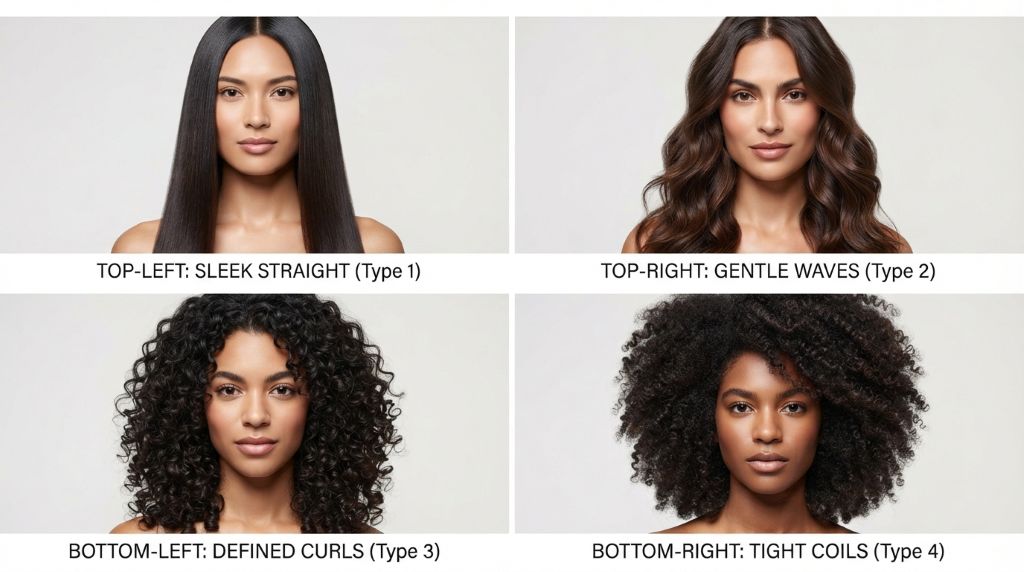
- Hair texture falls into four main types: straight, wavy, curly, and coily.
- Each texture type needs different products and care routines.
- Knowing your hair type helps you choose the right haircut and style.
- Genetics and follicle shape determine your natural hair texture.
- Proper care improves how your natural texture looks and feels.
Understanding your hair texture helps you choose better products and styles. Many people struggle with their hair simply because they use the wrong routine. However, learning your specific hair type changes everything. Therefore, this guide breaks down the four main hair textures. You’ll learn what makes each type unique and how to care for it properly.
What Determines Hair Texture?
Hair texture depends on the shape of your hair follicles. Round follicles produce straight hair, while oval follicles create curls. Additionally, genetics play the biggest role in determining your natural texture.
The hair shaft’s shape also affects how light reflects off strands. Straight hair often appears shinier because light travels evenly along the shaft. Curly and coily hair reflects light differently due to their bends and curves.
According to research published in the International Journal of Trichology, hair texture is classified based on curl pattern and follicle shape. This classification system helps people understand their unique hair type better.
Ethnic background also influences common hair texture patterns. However, hair texture varies widely within every ethnic group. Therefore, no single texture belongs exclusively to one group of people.
Hormones and aging can also change hair texture over time. Many people notice their hair becoming curlier or straighter as they age. Pregnancy and menopause are common triggers for these changes.
Understanding these factors helps explain why your hair behaves the way it does. Once you know what shapes your texture, you can choose better products. This knowledge also helps you set realistic expectations for styling and care.
Hair typing systems use numbers and letters to categorize texture types. The most common system ranges from type 1, which is straight, to type 4, which is coily. Each category also includes subtypes based on curl pattern.
Straight Hair: Characteristics and Care
Straight hair lacks any natural bend or curl pattern. It typically appears sleek, smooth, and shiny due to even light reflection. This texture falls under the type 1 category in most hair typing systems.
Straight hair tends to get oily faster than other textures. Natural oils from the scalp travel down the hair shaft easily. Therefore, straight-haired individuals often need to wash their hair more frequently.
This texture also has less volume compared to curly or coily hair. However, straight hair holds styles well and looks polished with minimal effort. It also tends to be more resistant to frizz in humid conditions.
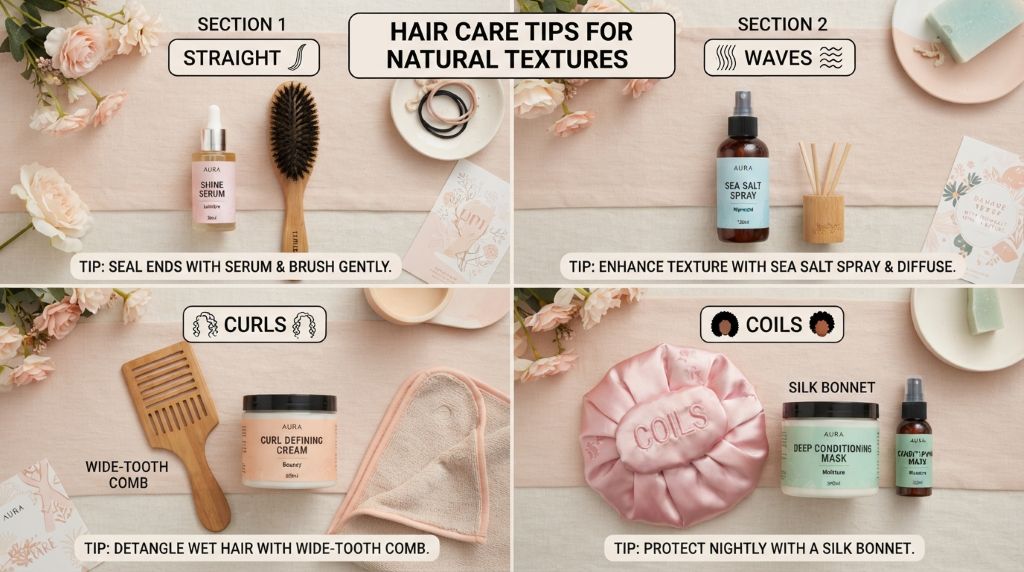
Follow these tips for caring for straight hair:
- Use lightweight shampoos to avoid weighing hair down.
- Apply conditioner mainly to the ends, not the scalp.
- Avoid heavy oils that can make hair look greasy.
- Use volumizing products to add body and lift.
- Limit heat styling to prevent damage and flatness.
Straight hair benefits from regular trims to prevent split ends. Since there’s no curl pattern to hide damage, split ends show more easily. Additionally, blunt cuts often work best for this texture.
Overall, straight hair is generally easier to manage and style. However, it still requires proper care to maintain shine and health. Simple routines with lightweight products work best for this hair type.
Wavy Hair: Characteristics and Care
Wavy hair falls between straight and curly, forming a loose S-shape pattern. This texture is classified as type 2 in most hair typing systems. It often looks tousled and naturally textured without much effort.
Wavy hair can vary significantly in thickness and curl definition. Some waves are barely noticeable, while others form more defined patterns. Additionally, humidity can affect how much wave or frizz appears.
This texture often struggles with frizz, especially in humid weather. However, the right products can enhance natural waves and reduce frizz. Wavy hair also tends to have more volume than straight hair.
Consider these care tips for wavy hair:
- Use a diffuser when blow-drying to enhance natural waves.
- Apply a light mousse or gel for definition without stiffness.
- Avoid brushing dry hair, which can cause frizz.
- Use sulfate-free shampoo to maintain natural moisture.
- Scrunch hair with a microfiber towel instead of rubbing.
Wavy hair benefits from layered haircuts that enhance movement. Layers help waves look more defined and less flat. Therefore, discussing layering options with your stylist can improve your natural texture.
This hair type requires a balance of moisture and lightweight products. Too much product can weigh down waves, while too little causes frizz. Finding the right routine takes some experimentation, but the results are worth it.
Curly Hair: Characteristics and Care
Curly hair forms well-defined spiral or corkscrew patterns. This texture falls under type 3 in most hair typing systems. It typically has more volume and bounce compared to straight or wavy hair.
Curly hair tends to be drier than other textures. Natural oils struggle to travel down the curved hair shaft. Therefore, curly-haired individuals need extra moisture to keep hair healthy and shiny.
This texture is also prone to frizz and shrinkage. Curls can appear shorter when dry due to their tight coil pattern. However, proper care techniques can enhance curl definition and reduce frizz significantly.
Follow these tips for caring for curly hair:
- Use sulfate-free, moisturizing shampoo to prevent dryness.
- Apply leave-in conditioner to keep curls hydrated throughout the day.
- Use the finger-coiling technique for better curl definition.
- Avoid brushing dry curls, which causes frizz and breakage.
- Sleep on a silk or satin pillowcase to reduce friction.
Curly hair benefits from the “plopping” method after washing. This technique involves wrapping hair in a soft towel to enhance curl formation. Additionally, deep conditioning weekly helps maintain moisture balance.
Regular trims prevent split ends from affecting curl pattern. Curly hair often looks its best with layered cuts that add shape. Overall, this texture requires consistent moisture and gentle handling for healthy results.
Coily Hair: Characteristics and Care
Coily hair forms tight curls or zigzag patterns close to the scalp. This texture falls under type 4 in most hair typing systems. It often has the most shrinkage compared to other hair types.
Coily hair is naturally the driest texture due to its tight curl pattern. Oils have the hardest time traveling down these tightly coiled strands. Therefore, this hair type requires the most intensive moisture routine.
This texture is also more fragile and prone to breakage. However, proper care techniques can help coily hair thrive and grow longer. Protective styles often help minimize daily manipulation and damage.
Consider these care tips for coily hair:
- Use rich, creamy moisturizers to combat dryness effectively.
- Deep condition weekly to maintain moisture and elasticity.
- Detangle gently using fingers or a wide-tooth comb.
- Try protective styles like braids or twists to reduce breakage.
- Seal moisture with natural oils like shea butter or coconut oil.
Coily hair benefits from the LOC method, which stands for liquid, oil, and cream. This layering technique locks in moisture effectively. Additionally, avoiding daily washing helps preserve natural oils.
This hair type often requires patience and consistent care. However, the results include healthy, defined coils with reduced breakage. Understanding coily hair’s unique needs leads to better overall hair health.
Conclusion
Understanding your hair texture helps you choose better products and styles. Whether you have straight, wavy, curly, or coily hair, proper care makes a difference. Each texture has unique needs that deserve attention and the right routine. Therefore, take time to learn what works best for your specific hair type. If you have curls, learning how to style short curly hair can also help you enhance your natural texture while maintaining definition and shape. With the right knowledge and care, your natural texture can look its healthiest yet.
Ready to embrace your natural texture? Book a consultation with a stylist who specializes in your hair type today.
Frequently Asked Questions
Can hair texture change over time?
Yes, hormones, aging, and health changes can alter your natural hair texture.
What hair type has the most shrinkage?
Coily hair typically shows the most shrinkage due to its tight curl pattern.
Is curly hair naturally drier than straight hair?
Yes, curly and coily hair struggle more to retain natural scalp oils.
How often should wavy hair be washed?
Wavy hair typically does well with washing two to three times a week.
Can I change my hair texture permanently?
Chemical treatments can alter texture, but they often cause damage over time.