
Most people assume that a pillow has to feel firm to support the neck properly. So when they sink into a plush hotel-style pillow and wake up without pain, it raises a fair question: is that softness actually helping, or is it just comfortable in the moment? The truth is that softness and support are not opposites. A well-made luxury hotel pillow alternative often proves this by combining a cloud-like feel with enough underlying structure to keep the neck neutral. The key is understanding how fill behaves, how you sleep, and where soft pillows tend to fail.
Quick Answer
Soft pillow fills can support proper spinal alignment when they have enough loft to fill the gap between your head, neck, and shoulder, and when the fill rebounds rather than collapsing flat. The fill material, your sleep position, and how you use the pillow matter more than firmness alone. A soft pillow that compresses to nothing will let your head drop, but a soft pillow with resilient fill and correct loft can keep your spine neutral while still feeling plush.
Key Takeaways
- Spinal alignment depends on loft and resilience, not just firmness. A soft pillow can support the neck if it holds its height under your head’s weight.
- Sleep position changes what you need. Back sleepers need less loft, side sleepers need more, and stomach sleepers need the least.
- Fill type determines how a soft pillow behaves. Down, down-alternative, and shredded memory foam each compress and rebound differently.
- You can adjust many soft pillows by adding or removing fill, which lets you tune loft to your body.
- A soft pillow that goes flat by morning is a support problem, not a comfort preference.
Why Softness and Support Are Not Opposing Forces
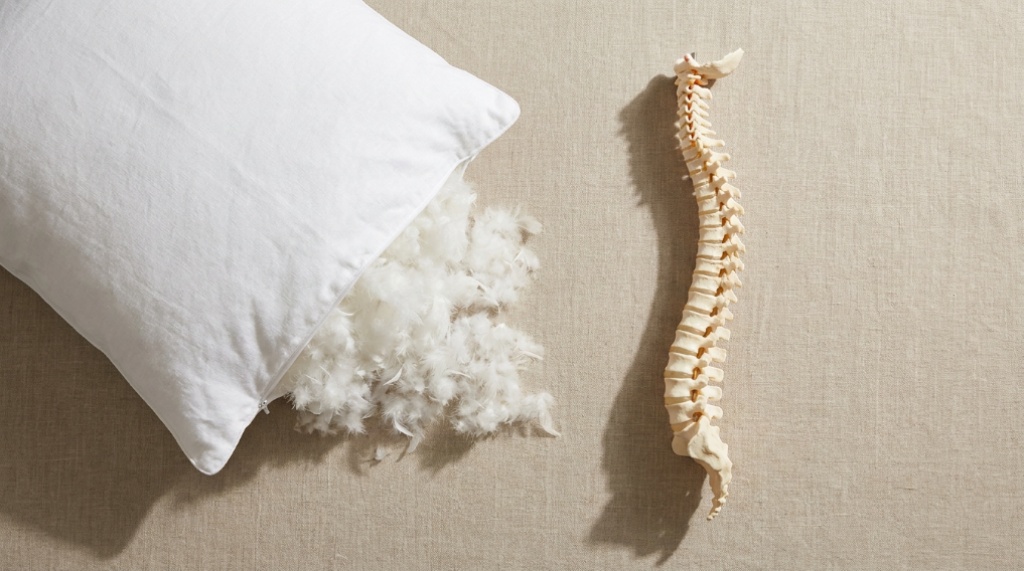
The confusion comes from treating firmness as the only measure of support. In reality, support is about whether a pillow keeps your head and neck in a neutral position relative to your spine. Firmness is just how the pillow feels against your head.
A pillow can be firm and still misalign your neck if it is the wrong height. It can be soft and still align your neck if it holds the right loft. The two qualities are separate, and that separation is what makes soft pillow fills viable for good spinal alignment.
What actually matters is loft (how tall the pillow sits) and resilience (how well it returns to shape after compression). A soft pillow with high resilience can cradle your head while still holding the neck up. A soft pillow with low resilience collapses and lets your head sink toward the mattress, which is where alignment problems begin.
How Soft Fills Behave Under Your Head
Different soft fills compress in different ways, and that behavior determines whether your neck stays neutral.
Down and Feather
Down clusters are very soft and compress easily, but quality down rebounds well and can be fluffed back into shape. The trade-off is that down offers little resistance, so it works best for back sleepers or those who need modest loft. Side sleepers often need a firmer or higher-loft pillow because down alone may not hold the shoulder gap.
Down-Alternative (Microfiber)
Down-alternative fills mimic the feel of down using synthetic fibers. They tend to be softer and more affordable, but their resilience varies widely. Cheaper versions flatten quickly and stay flat. Better-quality microfiber blends spring back reasonably well and can be adjusted by removing fill.
Shredded Memory Foam
Shredded memory foam is soft and moldable but has more underlying structure than down. It conforms to your head and neck while still providing resistance, which makes it a strong middle ground for people who want a plush feel without losing support. The fill can usually be added or removed to fine-tune loft.
Matching Loft to Your Sleep Position
Even the best soft fill will fail if the loft does not match how you sleep. Here is the general logic:
- Back sleepers: Need lower loft, roughly enough to fill the natural curve of the neck without pushing the head forward. A soft pillow with moderate loft usually works well.
- Side sleepers: Need higher loft to fill the space between the ear and the shoulder. A soft pillow can work here only if it holds its height; otherwise the head drops and the neck bends.
- Stomach sleepers: Need very low loft or no pillow at all under the head. A soft, thin pillow or a folded towel works better than a tall one.
- Combination sleepers: Benefit from an adjustable pillow they can reshape as they change positions during the night.
The test is simple: lie down and check whether your nose is roughly in line with the center of your chest. If your head is tilted up or down, the loft is wrong, regardless of how soft or firm the pillow feels.
When Soft Pillows Fail (and How to Fix It)
Soft pillows fail in predictable ways. Recognizing the failure mode helps you fix it instead of giving up on soft fills entirely.
| Problem | What It Feels Like | Practical Fix |
|---|---|---|
| Pillow goes flat by morning | You wake with a stiff neck and the pillow feels thin | Switch to a higher-resilience fill or a fill you can top up |
| Head sinks too low | Neck bends downward, chin drops | Add fill, fold the pillow in half, or use two thin pillows |
| Pillow pushes head forward | Chin tilts up, throat feels stretched | Remove fill or switch to a lower-loft option |
| Shoulder gap not filled | Neck feels unsupported on your side | Increase loft or choose a shredded fill that holds height |
Adjustable pillows are the most forgiving option because you can correct these problems without buying a new pillow. If your pillow has a zipper and loose fill, you already have a tuning tool, To explore more options for your bedroom setup, check out our guide on how to pick best budget latex pillows in pa.
What to Look For in a Supportive Soft Pillow
If you want the plush feel of a hotel pillow without sacrificing alignment, focus on these criteria:
- Resilience over softness alone. Squeeze the pillow and see whether it springs back. If it stays compressed, it will likely flatten overnight.
- Adjustable fill. A zipper and loose fill let you tune loft to your body and sleep position.
- Enough loft for your position. Side sleepers should look for a taller profile; back and stomach sleepers should look for a lower one.
- A fill that suits your temperature needs. Down breathes well; shredded foam can retain heat.
- A washable, breathable cover. This affects comfort and how long the fill maintains its behavior.
A soft pillow that meets these criteria can support alignment just as well as a firm one, often more comfortably.
Common Mistakes That Undermine Alignment
Even a good soft pillow can be used incorrectly. These mistakes are common and easy to correct:
- Using a pillow that is too tall for your position. This pushes the head forward and strains the neck.
- Ignoring the shoulder gap. Side sleepers often need more loft than they think.
- Never adjusting the fill. Many people leave a pillow at its factory fill level, which may not match their body.
- Stacking pillows without checking alignment. Two soft pillows can equal one firm pillow, but they can also create too much height.
- Keeping a worn-out pillow. Fill loses resilience over time, and a pillow that once supported you may no longer hold its loft.
Frequently Asked Questions
Can a soft pillow really support my neck?
Yes, if it holds enough loft and rebounds after compression. Softness describes the feel, not the support. A resilient soft pillow with the right height can keep your neck neutral.
Is a firm pillow always better for spinal alignment?
No. Firmness alone does not determine alignment. A firm pillow that is the wrong height can misalign your neck just as easily as a soft one. Loft and resilience matter more.
How do I know if my pillow is too soft?
If your head sinks until your neck bends downward, or if the pillow is flat by morning, it is too soft for your needs. Adding fill or switching to a more resilient fill usually solves this.
What is the best soft fill for side sleepers?
Shredded memory foam or a high-loft down-alternative tends to work well because it holds height while still feeling plush. Down alone often compresses too much for side sleeping.
How often should I replace a soft pillow?
It depends on the fill and how well it rebounds. When a pillow no longer springs back or needs constant fluffing to feel supportive, it is time to replace or refill it.
Conclusion
Soft pillow fills can absolutely maintain proper spinal alignment. What matters is not firmness but whether the pillow holds enough loft to keep your head and neck neutral, and whether the fill rebounds instead of collapsing. Match the loft to your sleep position, choose a resilient fill, and adjust it as needed. If your current pillow goes flat or leaves a gap at your shoulder, that is a fixable support problem, not a reason to abandon softness altogether.